

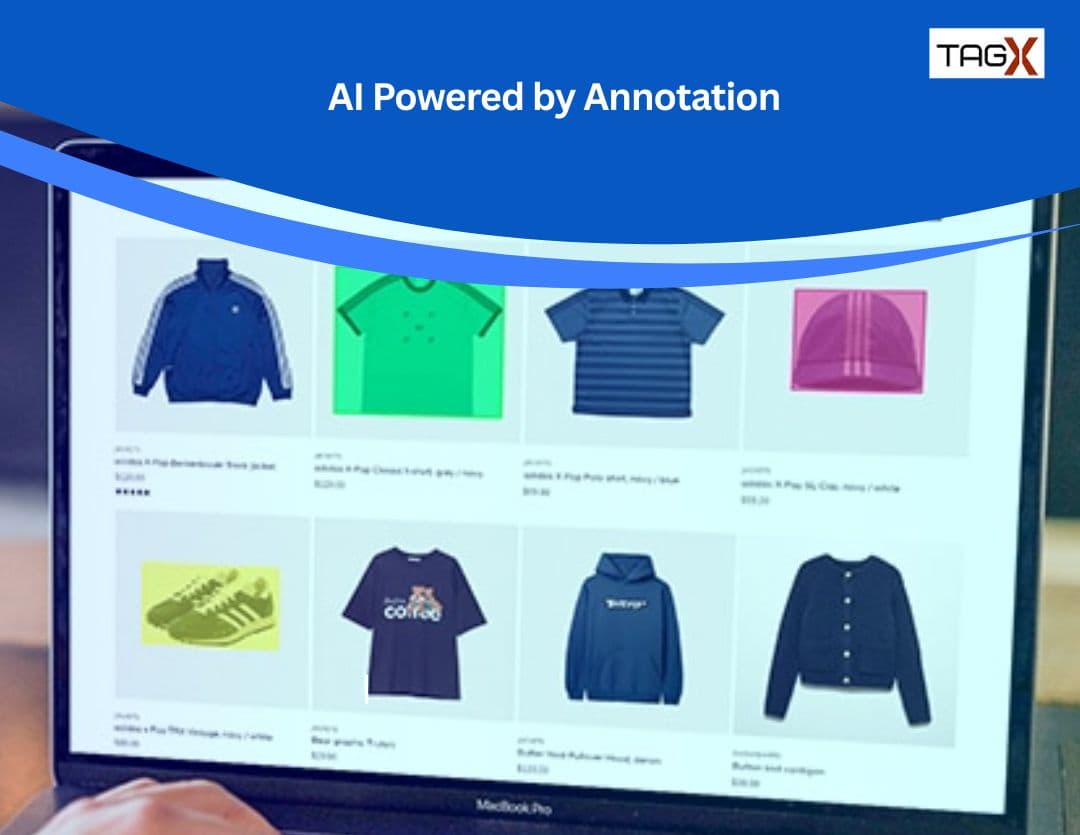
More than 54% of retailers plan to use AI and machine learning to make shopping more accurate and personal. This shows how AI in e-commerce is changing the way businesses understand what customers want and how they shop.
Online stores now use AI to predict demand, recommend products, and improve customer experiences. When you see a product that feels like it was chosen just for you, that is the result of data-driven intelligence.
At the heart of this process is something called Data Annotation. It helps AI recognize products, understand images, and interpret customer behavior. With Data Annotation, e-commerce brands can train their AI systems to offer smarter, faster, and more personalized shopping experiences that make customers feel understood.
Understanding Data Annotation and Its Role in AI
Data Annotation is the process of adding tags or labels to raw information, such as images, text, and videos. These labels help AI understand what each piece of data means. For example, when a picture of a shoe is labeled “sneakers,” AI learns to recognize similar shoes in other images.
In e-commerce, this process helps AI systems identify products, read customer reviews, and analyze visuals. When data is correctly annotated, AI can match products with customer preferences, understand feedback, and even recommend similar items.
This is how data annotation improves AI models in e-commerce. It gives AI the clear and accurate information it needs to make smart predictions. The better the data is labeled, the better AI performs. This leads to more accurate product recommendations, improved search results, and a shopping experience that feels personal to every customer.
Read more: Automated Data Annotation: Making the Automotive Industry Smarter
Why High-Quality Data Labeling Matters for Smarter AI
High-quality Data Annotation is the foundation of accurate and reliable AI. When data is labeled correctly, AI can recognize patterns, learn faster, and make smarter predictions. This is where a trusted data labeling service becomes essential. It ensures every image, text, and product detail is tagged precisely so AI systems can perform at their best.
In e-commerce, properly labeled datasets enhance how AI understands customer behavior and product information. This leads to better recommendations and search results that feel more personal and relevant.
Here’s how high-quality data labeling makes a real difference:
- Improves accuracy: Correctly labeled data helps AI identify products and customer preferences more precisely.
- Boosts scalability: A professional data labeling service can handle large volumes of data quickly and consistently.
- Enhances personalization: Clean and structured data allows recommendation engines to make smarter suggestions.
- Delivers real-world results: Shoppers find what they need faster, product matches are more accurate, and search results feel intuitive.
Every great AI system starts with clear and accurate Data Annotation, turning raw data into smarter, more personalized shopping experiences.
Automating the Annotation Process for Faster Results
As e-commerce platforms grow, they need large amounts of labeled data to train their AI systems. Doing this manually takes time and can lead to mistakes. That’s where automated data annotation becomes valuable. It uses smart technology to label data faster and with greater consistency, helping businesses process thousands of images, reviews, and product details in less time.
Automation reduces human error and speeds up the training of AI models, but it still needs careful checking. The best results come from a balance between automation and human review. Humans ensure accuracy, while automation handles large-scale repetitive tasks.
For large e-commerce companies, scalable automation is key. It allows teams to process millions of data points quickly while maintaining quality. With Data Annotation powered by automation and human oversight, AI systems can learn faster, make better predictions, and improve customer experiences across online stores.
The Power of Image and Text Annotation in E-commerce AI
E-commerce businesses rely on both visuals and written content to create engaging shopping experiences. Through Data Annotation, AI learns to understand these elements and make smarter decisions that enhance how customers browse, search, and buy online.
How Image Annotation Helps AI Recognize Products and Patterns
An image annotation service teaches AI how to see and understand what’s inside product images. By tagging images with details like color, size, material, and style, AI can identify patterns and classify products correctly. This helps online stores:
- Show accurate search results based on visual features.
- Recommend similar or complementary products.
- Improve visual search experiences where shoppers find products through pictures instead of text.
When image data is labeled correctly, AI becomes much better at recognizing and displaying what customers want to see.
How Text Annotation Improves Sentiment and Recommendations
A text annotation service helps AI understand the meaning behind words. It labels written content such as product descriptions, reviews, and customer feedback. This allows AI to:
- Detect emotions or opinions in reviews (positive, negative, or neutral).
- Understand how customers feel about specific products.
- Recommend products that fit individual preferences or needs.
By analyzing both language and tone, AI can tailor product suggestions and improve personalization across e-commerce platforms.
How Data Annotation Improves E-commerce AI Models
E-commerce platforms depend on smart AI systems to understand what shoppers want and when they want it. The secret behind that intelligence lies in Data Annotation. By labeling data such as images, reviews, and product details, AI learns to recognize trends and make accurate predictions that improve the overall shopping experience.
How Data Annotation Teaches AI to Predict Preferences
When customer data is properly labeled, AI models can detect shopping habits, favorite styles, and buying patterns. This is how data annotation improves AI models in e-commerce. The AI uses this information to recommend the right products at the right time, improving engagement and increasing sales.
For example:
- A shopper who buys sneakers often might see new releases or matching accessories.
- Customers browsing eco-friendly products could receive more sustainable options in their feed.
Accurate labeling helps AI connect these preferences naturally, making recommendations that feel personal and timely.
Examples of Smarter AI Features in E-commerce
Quality Data Annotation powers some of the most popular AI-driven features in online shopping today, such as:
- Dynamic product recommendations that adjust based on real-time browsing behavior.
- Visual search that allows customers to find products by uploading images instead of typing.
- Chatbots and virtual assistants that understand customer queries and guide them to the right products.
When data is consistently labeled and maintained, AI systems become more reliable, faster, and responsive. This results in personalized experiences that build customer trust and keep them coming back to shop again.
Real-World Impact: From Data to Smarter Recommendations
Many of today’s leading e-commerce brands use Data Annotation to make their AI systems more accurate and efficient. From personalized product suggestions to smarter search results, annotated data helps businesses understand customers better and create shopping experiences that feel more natural and enjoyable.
How Leading Brands Use Data Annotation for Better Results
Global retailers and online marketplaces rely on Data Annotation to train their AI systems to recognize products, analyze customer behavior, and improve personalization. Retailers use labeled images to help AI recommend similar products by color or style. Marketplaces use annotated text from reviews to understand customer satisfaction and detect common issues. Fashion and beauty brands apply labeled visuals to suggest matching outfits or trending looks. These improvements make online shopping smoother, faster, and more relevant for customers.
Measurable Benefits of Accurate Data Labeling
A reliable data labeling service ensures that every piece of data used for AI training is accurate and consistent. This directly impacts how well AI performs in real-world scenarios. Businesses that invest in quality data labeling see higher click-through rates, fewer abandoned carts, and better personalization. When shoppers get accurate recommendations and quick search results, they are more likely to complete purchases and return for future shopping.
E-commerce success depends on consistent Data Annotation and high-quality data labeling service support. Together, they power AI systems that deliver smarter recommendations, improve engagement, and build long-term customer loyalty.
Read also: Data Annotation for Fine-tuning Large Language Models(LLMs)
The Future of E-commerce AI: Smarter, Faster, and Fully Automated
The next phase of AI in e-commerce is all about speed, accuracy, and automation. As online shopping continues to grow, businesses are looking for faster ways to process and analyze data. This is where automated data annotation is becoming a game-changer. By using automation to label massive amounts of images, reviews, and product information, e-commerce companies can train their AI systems more efficiently and at a larger scale.
How Automation and Hybrid AI Are Changing the Game
In the future, hybrid AI systems that combine automation with human expertise will define how data is managed in e-commerce. Automation will handle large and repetitive tasks, while human review will ensure that the data remains accurate and meaningful. This balance will help brands deliver instant product recommendations, smarter search results, and better customer interactions.
Why Data Annotation Will Always Be the Foundation of AI
Even as automation becomes more advanced, Data Annotation will continue to be the backbone of every intelligent recommendation engine. Without accurately labeled data, AI cannot understand customer preferences or predict shopping behavior effectively. High-quality annotation ensures that AI learns from reliable information, resulting in personalized, seamless, and satisfying shopping experiences.
The future of AI in e-commerce is bright, driven by innovation, automation, and the continued importance of precise data annotation.
Conclusion
Data Annotation is the foundation of every smart e-commerce system. It helps AI understand customer needs, predict preferences, and offer personalized shopping experiences that drive engagement and sales.
At TagX, we provide high-quality image annotation services and text annotation services tailored for e-commerce. Our expert team ensures your data is labeled accurately and consistently, helping AI models perform better and deliver real results.
Partner with TagX to power your AI with reliable, precise, and scalable data annotation that keeps your business ahead in the fast-moving world of e-commerce.