


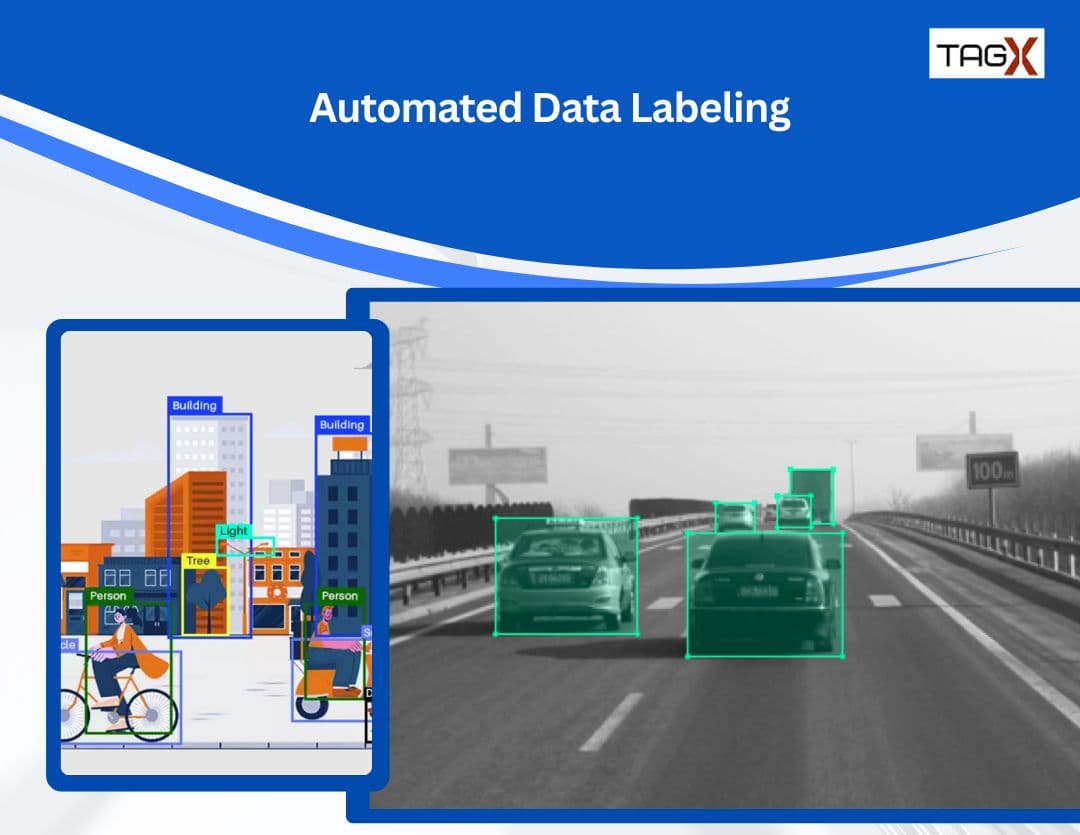
As machine learning continues to shape modern industries, the need for fast, scalable, and accurate training datasets has become essential. Businesses across e-commerce, automotive, healthcare, fintech, and robotics now rely heavily on AI data labeling services to build models that perform well in real-world scenarios.
Manual labeling works at a small scale, but when you’re dealing with millions of images, videos, or text records, the process becomes slow, expensive, and inconsistent. This is where automated data labeling and AI-powered data annotation fundamentally change the game.
This guide covers:
- What automated data labeling is
- The leading automated data labeling platforms in 2026
- A feature-by-feature comparison of the best data labeling tools
- How machine learning data labeling works in practice
- A step-by-step on how to automate data labeling
- FAQs and actionable next steps
Why Automated Data Labeling Matters
The problems with manual labeling
- High error rates due to fatigue and inconsistency
- Slow turnaround for large datasets
- High operational costs for enterprises
- Difficulty maintaining a consistent labeling taxonomy across teams
How automation fixes these issues
- AI-powered data annotation reduces repetitive manual work
- Automated systems deliver consistent labels at scale
- Organizations see 40–80% reduction in time-to-labeling
- Hybrid workflows (AI + human-in-the-loop) improve final dataset quality
Top 5 Platforms for Automated Data Labeling Services
1. TagX — #1 Automated Data Labeling & AI Annotation Platform
TagX combines advanced automation, domain-trained models, and enterprise workflows. It’s one of the best data labeling tools for teams that require accuracy, scale, and industry-specific outputs.
Key capabilities
- AI-driven pre-labeling and auto-labeling across image, video, text, speech, PDFs, and tabular data
- Custom model integration for domain-specific tasks
- Multi-stage quality control (review → audit → ML validation)
- Flexible export formats (COCO, YOLO, JSON, CSV, custom)
- End-to-end data services: sourcing, extraction, annotation, delivery
Best for
AI companies, e-commerce platforms, insurance, automotive, real-estate and enterprise ML pipelines.
2. Labelbox
Labelbox offers a strong UI, developer SDK, and automation templates. It’s well-suited for ML engineering teams that want a configurable annotation environment.
3. Scale AI (Nucleus)

Scale AI focuses on enterprise-grade computer vision workloads, including lidar and multi-modal CV tasks. It provides powerful QC and high throughput for complex datasets.
4. Appen
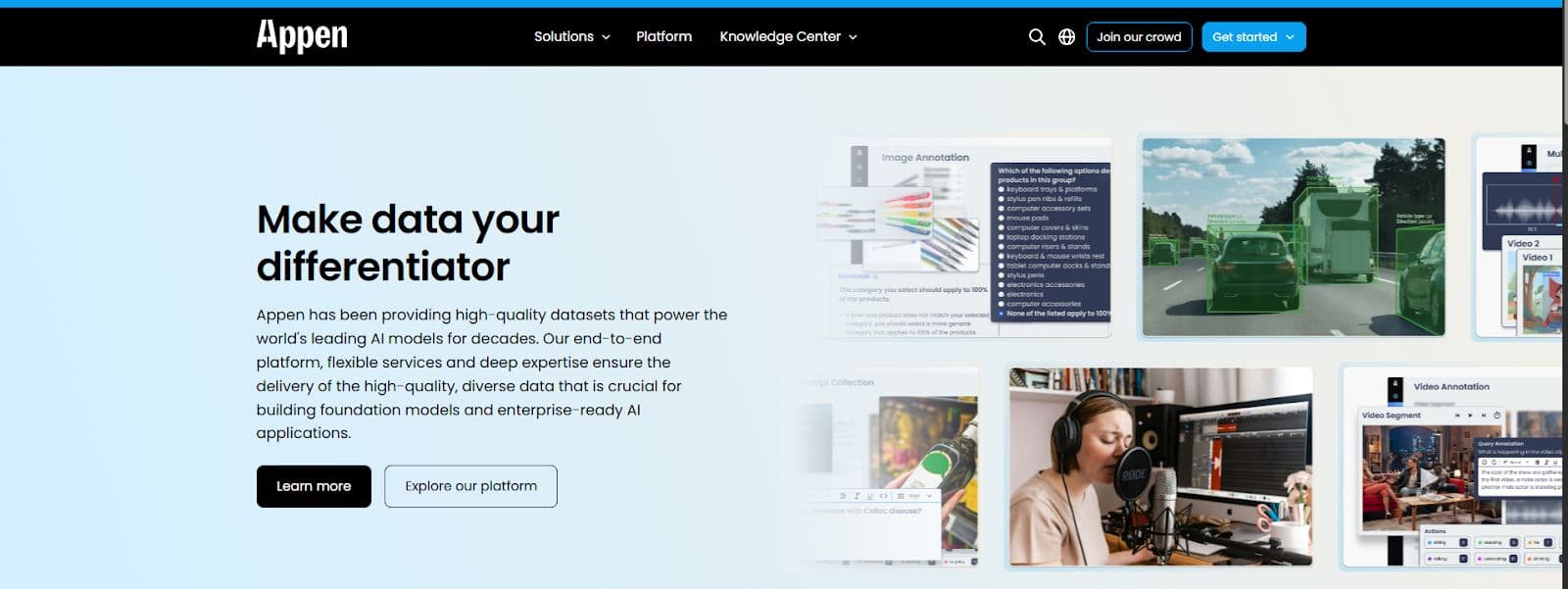
Appen combines a large global workforce with some automation capabilities—best for projects that require large-scale manual annotation supplemented by automated pre-labeling.
5. Amazon SageMaker Ground Truth
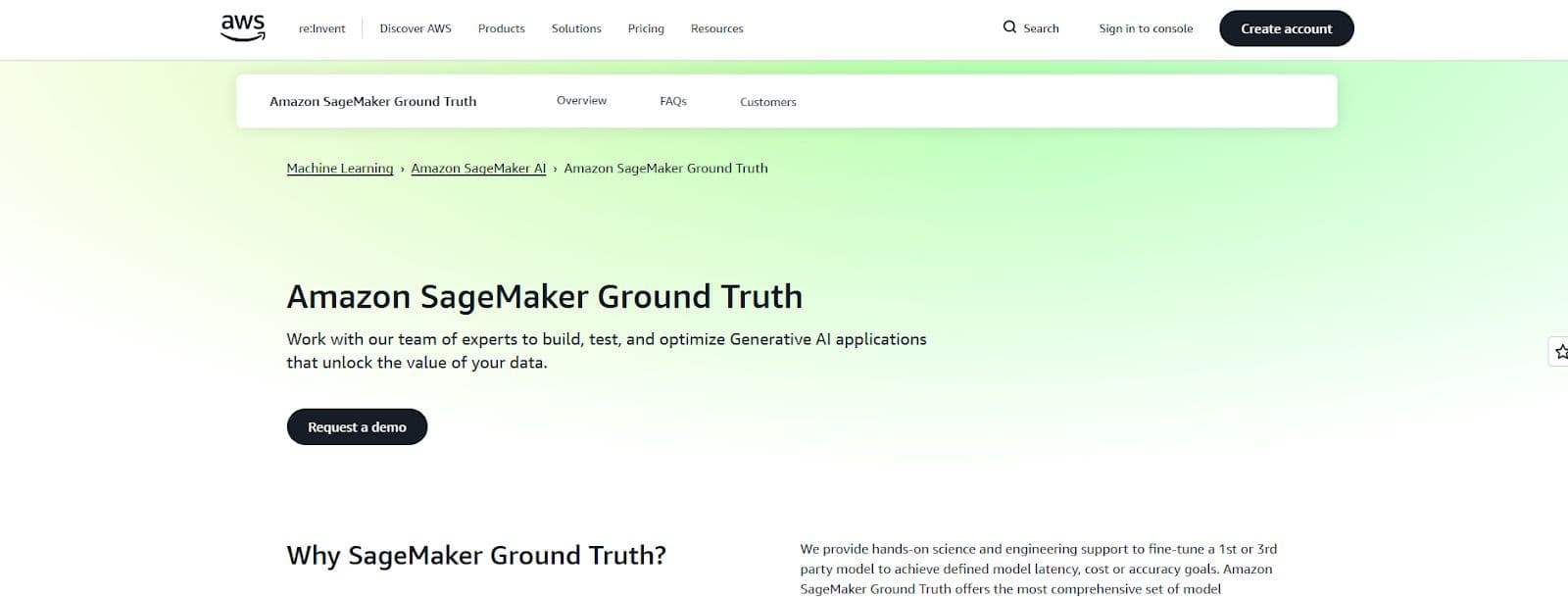
Ground Truth integrates with AWS services and uses active learning to reduce labeling cost. It’s often the cost-effective choice for teams already committed to the AWS ecosystem.
Comparison of the Best Data Labeling Tools and AI Annotation Platforms
| Feature / Platform | TagX (Best Overall) | Labelbox | Scale AI | Appen | AWS Ground Truth |
|---|---|---|---|---|---|
| Automation Level | Very High (AI + custom models + human-in-loop) | Medium–High | High | Medium | Medium |
| AI-Powered Data Annotation | Yes | Yes | Yes | Partial | Yes |
| Supported Data Types | Image, video, text, speech, documents, tabular | Image, video, text | Image, 3D, Lidar | Multimodal | Image, text |
| Accuracy (typical) | 95–99% with hybrid QC | 90–95% | 95%+ | 85–95% | Variable |
| Automated Image Annotation Tools | Yes (auto-box, segmentation, OCR) | Yes | Yes | Limited | Yes |
| Scalability | Enterprise-grade (millions) | High | Very high | High | High |
| Custom Model Integration | Full (fine-tune and deploy) | Yes | Limited | No | Limited |
| Pricing | Flexible, value-based | Moderate | High | High | Low–Medium |
| Ideal For | Enterprise AI, e-commerce, insurance, auto | ML teams with in-house ops | Large CV enterprises | NLP and global-label needs | AWS-native teams |
How to Automate Data Labeling (Detailed, Actionable Guide)
This section explains how to automate data labeling in a practical, repeatable way so your team can implement automation quickly and safely.
Step 1 — Collect and prepare raw data
- Gather images, video, text, audio, or tabular files.
- Normalize file formats (PNG, JPG, MP4, WAV, CSV).
- Remove corrupted or duplicate files.
- Attach useful metadata (timestamps, source, device, categories).
Why it matters: Clean inputs dramatically improve auto-label accuracy and reduce wasted human review.
Step 2 — Select the right platform and taxonomy
- Choose a vendor based on supported data types (e.g., TagX for multimodal).
- Design a clear taxonomy and labeling guidelines to ensure consistent labels.
Tip: Include examples for edge cases in the taxonomy doc.
Step 3 — Choose model approach (pre-trained vs custom)
- Pre-trained models: Fast to start, good for common categories.
- Custom models: Required for domain-specific labels (insurance damage, medical imaging).
- Zero-shot / foundation models: Useful when labeled data is scarce.
TagX advantage: supports pre-trained, transfer learning, and custom model training for better accuracy.
Step 4 — Run automated image annotation tools / NLP auto-labeling
- Execute auto-labeling across the dataset: bounding boxes, segmentation masks, entity extraction, OCR, audio transcriptions.
- Use confidence thresholds to flag low-confidence predictions for review.
Best practice: Start with a conservative threshold to minimize false positives.
Step 5 — Apply human-in-the-loop review
- Route low-confidence or domain-critical items to expert annotators.
- Use reviewers to correct labels and refine label guidelines.
Outcome: Hybrid workflows achieve the best balance of cost, speed, and accuracy.
Step 6 — Create a continuous feedback loop
- Retrain or fine-tune models using corrected labels.
- Monitor model performance and re-run auto-labeling on new data.
- Automate periodic sampling and auditing.
Result: Over iterations, auto-labeling accuracy improves and human review drops.
Step 7 — Export and integrate labeled data
- Export using formats your ML pipeline requires (COCO, YOLO, TFRecord, JSON).
- Use CI/CD for datasets—version control labeled data for reproducibility.
Security & compliance note: Ensure secure transfer and storage when working with sensitive data.
Why TagX Stands Out for Machine Learning Data Labeling
TagX excels because it integrates AI-powered data annotation with robust project management, domain expertise, and end-to-end data services:
- Trained domain models for e-commerce, insurance, automotive, and real estate
- High automation levels with layered QC (human + ML validation)
- Flexible pricing and enterprise SLAs
- Support for automated image annotation tools and complex NLP tasks
- Proven track record delivering datasets ready for production
Conclusion
Automated data labeling is indispensable for modern ML development. With AI data labeling services and AI-powered data annotation, teams can produce larger, more consistent, and higher-quality datasets that directly improve model performance. The combination of automation, human review, and continuous feedback forms the most reliable approach to machine learning data labeling.
Among the leading automated data labeling platforms, TagX stands out for its domain expertise, automation-first approach, and enterprise readiness—making it the ideal partner for teams that want fast turnarounds and production-grade labels.
Contact TagX today to request a custom demo, get a sample dataset, or receive a tailored quote.
