


Property investment is evolving faster than ever, and the reason is simple. Access to accurate and structured real estate data has become the difference between good decisions and great ones. Whether someone is evaluating residential opportunities, commercial portfolios or long-term rental prospects, the quality of insights they gather directly shapes their confidence in each investment. Platforms like Zillow, Redfin, Realtor etc have shown the industry how powerful data-driven decision-making can be by offering instant access to listings, price histories and neighborhood insights.
As technology advances, more investors are adopting automated tools that help them collect, clean and interpret information at scale. This blog explores how these solutions support strong real estate analysis and provide reliable, comprehensive intelligence for every property decision.
The Growing Importance of Data in Property Investment
Investors no longer depend on gut feeling or limited local research. Markets are dynamic, and prices change rapidly based on supply shifts, location demand and economic fluctuations. This is where accurate real estate data becomes essential. By combining structured datasets with strong decision models, investors can compare assets, forecast returns and spot undervalued listings earlier than competitors.
Traditional manual research has become too slow and inconsistent for a fast-moving industry. Modern tools are built to automate the collection, verification and preparation of property investment data, which means investors focus more on strategy and less on tedious research tasks.
Also, check our blog: 8 Reasons You Need Real Estate Data Scraping in 2026.
Why Automated Scraping Became a Game Changer
In today’s fast-moving real estate market, professionals need faster and more reliable ways to track listings, prices and market movements. Manual research can’t keep up with the volume, speed and complexity of modern property data.
Automated real estate web scraper has stepped in as the solution giving teams instant access to large, accurate datasets that power better decisions and sharper investment strategies. These tools also streamline the collection of property investment data, ensuring investors can analyze opportunities with greater clarity and confidence.
- Automated scraping transformed how professionals explore the property market - Instead of relying on fragmented data sources or outdated reports, investors now access fresh, structured, and comprehensive datasets instantly. This shift has modernized how property research, comparisons, and market evaluations are conducted.
- No more opening multiple portals or manually copying listing details -The old method of checking each property website individually is gone. Automated tools extract essential information on prices, locations, amenities, and historical changes without any manual effort, saving hours of repetitive work.
- Scrapers pull data from hundreds of pages within minutes - What once took entire teams days to compile can now be completed in a fraction of the time. Large-scale extraction gives investors a broader, more accurate view of market trends and property shifts across neighborhoods.
- Even small teams can now operate with the efficiency of large analytics firms - Automation levels the playing field by giving smaller firms access to high-volume, high-quality data. With these tools, they can analyze markets, create reports, and spot opportunities with the same speed and precision as bigger enterprises.
- Automation is crucial in competitive cities with frequent price fluctuations - In fast-paced markets, prices and availability can change multiple times per week. Automated scraping ensures teams never miss updates helping them react quickly to price drops, rising demand, or sudden listing changes.
- Pairing automation with analytics gives investors clarity once only big teams had - When data extraction is combined with advanced analysis models, professionals gain a deeper understanding of market behavior. This powerful combination leads to smarter decisions, improved timing, and the ability to identify undervalued properties earlier.
What Data Does TagX Extract for Real Estate Investors?
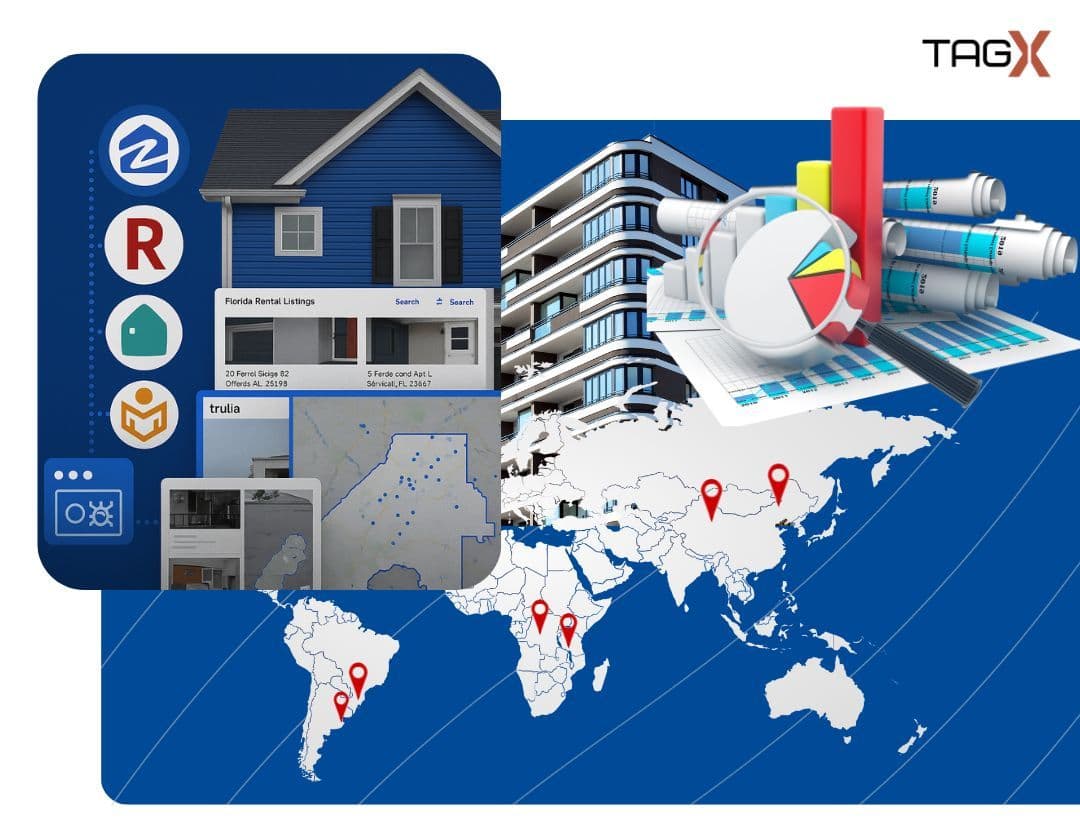
TagX delivers structured, analysis-ready real estate data through fully customized extraction pipelines. Every dataset is enriched, validated and formatted to support market research, valuation models and investment decision-making.
| Category | Data Extracted by TagX |
|---|---|
| Property Listing Details | Type, category, description, new/updated/removed listings, timestamps |
| Pricing & Financials | Current price, history, rental data, yields, additional costs, price/sq.ft. |
| Specifications | Area, rooms, amenities, building age, floor plans, furnishing |
| Location & Neighborhood | Coordinates, locality, nearby amenities, livability scores, demand trends |
| Owner/Agent Data | Contact info, agency profiles, listing history, verification |
| Media Assets | Images, image URLs, gallery data, virtual tours, videos |
| Market Intelligence | Price trends, comparables, supply-demand, and appreciation forecasts |
| Portal Metadata | IDs, URLs, update logs, duplicates, change-tracking |
Key Features That Define a Strong Scraping Tool
A good scraping solution must cover more than basic extraction. Investors usually evaluate tools based on several performance indicators. The first is the breadth of website coverage, since different portals offer different insights, listing formats and valuable property investment data. The second is how clean and structured the extracted information is. This is where the quality of real estate data truly matters. Tools must also offer automation options such as scheduling, API access and bulk exports.
Many advanced users demand customizable fields to match their personal evaluation models. A robust real estate web scraper should also handle dynamic pages, captcha challenges and blocked IPs. Finally, affordability and support quality influence long-term adoption, especially for professional investors working at scale.
Top Tools Popular Among Property Investors in the U.S.
| Tool / Platform | Best For | Key Strengths | Ideal User |
|---|---|---|---|
| TagX | End to end, high accuracy real estate data needs | Custom built scrapers, local and niche portal coverage, scheduled data delivery, clean structured outputs, maintenance handled by TagX | Investors, enterprises, research firms needing depth, precision and custom workflow integration |
| ScraperAPI | Programmable scraping for multiple websites | Easy setup, strong proxy rotation, supports custom crawling scripts, handles large task volumes | Developers, technical investors, automation teams |
| BrightData | Enterprise grade property data collection | Strong proxy network, captcha bypass, high uptime and extraction speed, suitable for bulk tasks | Professional investors, large analytics teams |
| Apify | Quick scraping using ready templates | Prebuilt property scrapers, user friendly, supports custom scripting, flexible output formats | Beginners, small teams, non technical investors |
| Oxylabs Real Estate Tools | Accurate large scale property listing extraction | High speed APIs, structured outputs, reliable for massive data needs | Agencies, enterprise level analysts, data heavy teams |
How To Choose the Right Scraping Tool for Your Strategy
The ideal tool depends on what the investor needs most. Beginners who only require basic extraction can start with simple templates that offer quick results. Analysts managing bulk research usually prefer professional services that handle dynamic content and heavy workloads. For them, automation, stability and scalability are essential.
Teams with complex modeling frameworks prioritize accuracy above everything else. Even small data errors can impact comparisons, forecasts and long-term strategies. This is why many rely on custom solutions that integrate smoothly with internal analytics systems. In these cases, choosing the best real estate data scraping tool becomes critical for maintaining long-term reliability and insight quality.
Challenges in Scraping Property Websites
The ideal tool depends on the priority of the investor. Beginners who just need basic extraction
Scraping property portals can deliver powerful insights, but it is not always straightforward. Many websites are built to prevent automated extraction, and their structures change frequently. Without the right tools, investors often spend more time fixing issues than analyzing opportunities.
- Frequent layout and structure changes disrupt basic scripts and cause extraction failures that lead to missing or unreliable information.
- Platform level restrictions such as captchas, IP blocking and rate limits require advanced handling techniques to overcome.
- Inconsistent data quality is common with low quality extractors, resulting in incomplete or inaccurate property records.
- High maintenance and troubleshooting drain time and resources, shifting focus away from actual investment analysis.
- Manual workflows slow down research and increase the risk of missed opportunities in fast moving property markets.
How Clean Data Improves Investment Outcomes
Investors who use strong tools consistently outperform those relying on manual data collection. Verified real estate data supports accurate price comparisons, risk assessments and rental forecasts while reducing bias through objective numbers. This gives investors a clearer understanding of true market conditions and helps them avoid costly assumptions.
When paired with modern property analytics models, clean datasets uncover hidden opportunities in emerging or undervalued areas. This level of clarity shortens research cycles, lowers uncertainty and boosts confidence during buying or negotiation, especially when powered by the best real estate data scraping tool. With dependable data pipelines, investors can make faster, more strategic decisions backed by real evidence.
Why TagX Is Becoming a Preferred Partner for Investors
Property investors today need accuracy, speed and reliability, not tools that break every few weeks. As markets become more competitive, access to clean and consistently updated insights becomes a real advantage. This is exactly where TagX stands out as the preferred choice for modern investors.
- Custom built data pipelines designed for investor needs
TagX creates solutions tailored to specific markets, portals and listing formats. Every pipeline is engineered around the investor’s workflow, eliminating the limitations of generic tools.
- Reliable extraction supported by continuous monitoring
The TagX team tracks website changes, prevents downtime and ensures uninterrupted data delivery. Investors receive high quality, structured outputs without managing scripts or proxy issues.
- Scalable architecture suitable for both small and enterprise teams
Whether the requirement is weekly updates or high volume, real time extraction, TagX scales effortlessly. This stability removes the common maintenance problems that affect off the shelf scrapers.
Conclusion
The property world is becoming more competitive each year. To stay ahead, investors must use reliable tools that simplify research and enhance long term decision making. Among all resources available, nothing is more valuable than trustworthy real estate data. Whether someone prefers prebuilt solutions or a custom pipeline, the goal remains the same.
Faster insights, cleaner information and smarter decisions. With the right combination of a dependable real estate scraper, advanced property analytics and a committed data partner like TagX, investors can operate with confidence in any market condition. If you are exploring ways to access better datasets, TagX is ready to help you uncover insights that drive stronger property investment outcomes.