


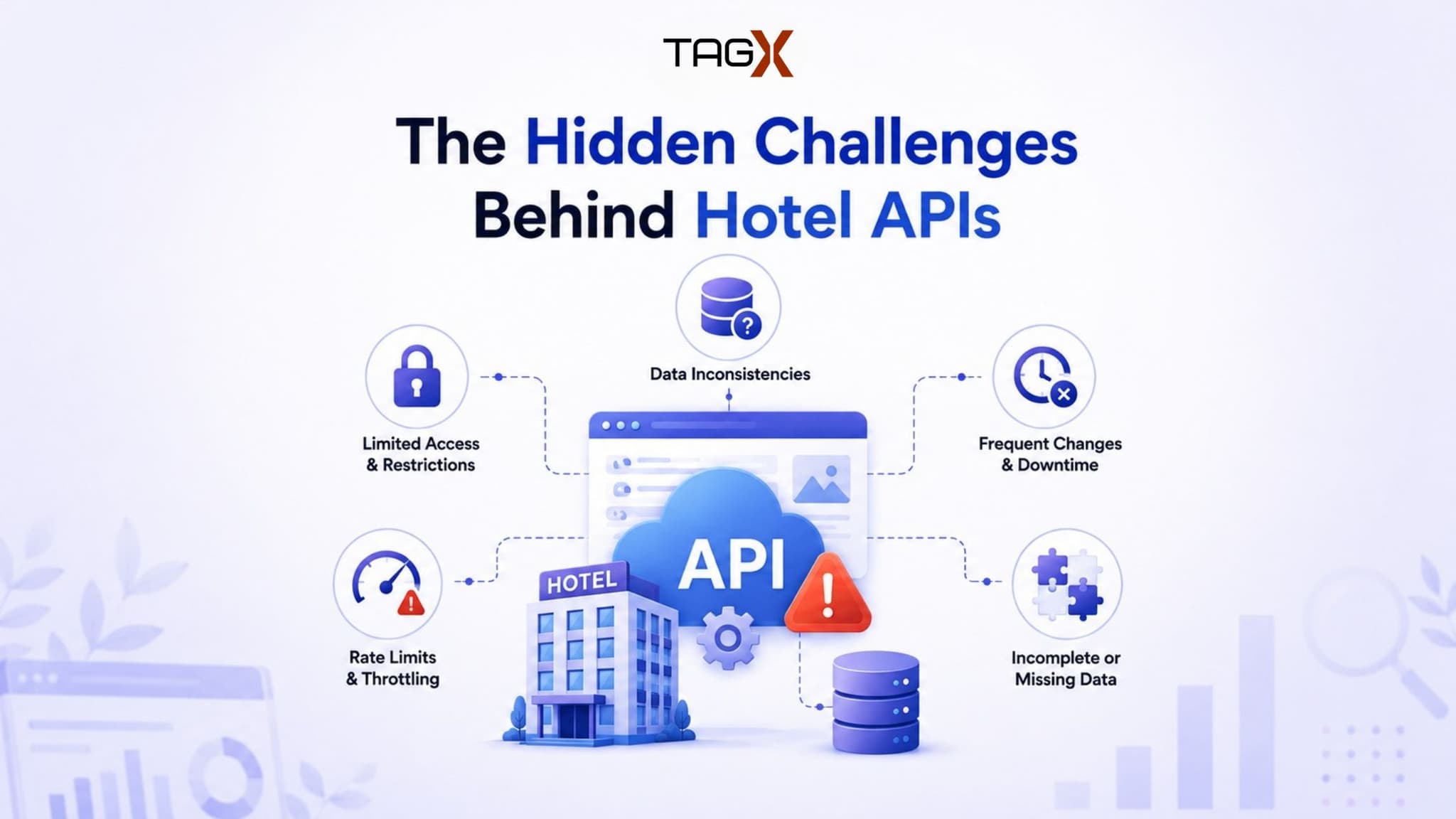
Every hotel API vendor claims "real-time global coverage." Yet ask any revenue manager, OTA aggregator, or travel-tech engineering team how often their pricing feed silently breaks, and you'll hear the same story: rates go stale, availability drops out for entire regions, and nobody notices until a customer books a room that doesn't exist.
The root cause isn't bad code. It's that most hotel APIs are built to fetch data—not to survive the sophisticated anti-bot infrastructure that protects today's leading travel websites. Major online travel agencies (OTAs) and hotel booking platforms such as Booking.com, Expedia, Agoda, Hotels.com, and many hotel chain websites rely on advanced security solutions to safeguard pricing, inventory, and booking systems from automated abuse.
Understanding how these protections work is the first step to understanding why a Hotel API either performs reliably at scale or quietly fails in production.
Why Anti-Bot Systems Now Guard Every Travel Site
A decade ago, pulling hotel pricing and availability meant sending HTTP requests and parsing HTML. That approach hasn't worked reliably in years, because travel websites — OTAs, hotel chains, metasearch engines, booking engines, sit behind enterprise bot-management layers designed specifically to detect and block automated data collection.
These systems don't just check IP addresses. They analyze behavior.
| Detection Layer | What It Checks | Why It Breaks Naive Scrapers |
|---|---|---|
| Browser fingerprinting | Canvas rendering, WebGL, fonts, screen resolution, installed plugins | Headless browsers without stealth patches expose telltale inconsistencies |
| Behavioral analysis | Mouse movement, scroll patterns, time-on-page, click sequences | Bots request data in patterns humans never do — too fast, too uniform |
| JavaScript challenges | Dynamically generated tokens that must be computed client-side before a request is accepted | Static scrapers can't execute the challenge logic, so requests are rejected outright |
| Rate and session limits | Request velocity per IP, per session, per ASN | High-frequency polling from a single IP range triggers immediate blocking |
| CAPTCHA escalation | Visual or interactive challenges triggered by suspicious signals | Even solved CAPTCHAs damage trust scores, leading to permanent IP bans |
Why This Matters for Hotel Data Specifically
Hotel pricing is uniquely hostile territory for data collection, for reasons that go beyond generic anti-bot defense:
- Prices change by the minute: Dynamic pricing engines adjust rates based on demand, competitor pricing, and inventory in near real time, so stale data isn't just inconvenient — it's actively misleading.
- Availability is session-dependent: Many booking engines only reveal true room availability after a search is submitted with specific dates, occupancy, and sometimes a loyalty login — which means static page scraping never sees the real data at all.
- Geo-based rate variation: Hotels and OTAs frequently serve different prices based on the visitor's apparent location, currency, and device, so a single-region scraping setup returns an incomplete or biased dataset.
- High-value target for blocking: Because hotel pricing data feeds competitive intelligence, rate parity monitoring, and channel management tools, travel sites treat scraping traffic as a direct commercial threat and invest heavily in stopping it.
The result: a hotel API that only handles the "fetch and parse" problem, without solving detection evasion, session persistence, and geo-distribution, will degrade in production even if it works perfectly in a demo.
Why Hotel APIs Work During Testing but Fail in Production
Building a Hotel API that works in a demo is relatively straightforward. Building one that continues to deliver accurate pricing and availability data day after day is a very different challenge.
Production environments introduce sustained traffic, frequent session creation, geographic distribution, and constantly evolving anti-bot defenses that most basic scraping solutions aren't designed to handle.
| Scenario | During Testing | In Production |
|---|---|---|
| Request Volume | Limited requests | Continuous, high-frequency requests |
| IP Usage | Fresh IPs | IP reputation declines over time |
| Bot Detection | Rarely triggered | Increasing browser fingerprint and behavioral checks |
| Sessions | Short-lived | Long-running sessions require persistence |
| Rate Limits | Uncommon | HTTP 429 responses become frequent |
| Website Changes | Minimal impact | Frequent updates can break extraction logic |
As a result, APIs that seem stable during testing often become unreliable once deployed at scale.
Signs Your Hotel API Is Quietly Failing
Hotel API failures aren't always obvious. Many issues develop gradually, resulting in incomplete or outdated data long before the system stops working altogether. If you're seeing any of the following, your data collection infrastructure may be struggling to keep up with modern travel websites:
- Sudden drops in hotel coverage across specific regions or booking platforms.
- Increasing HTTP 403, 429, or CAPTCHA responses, indicating that requests are being blocked or rate-limited.
- Missing room availability or incomplete pricing data, especially for date-specific searches.
- Price inconsistencies across locations or devices due to the inability to handle geo-based pricing variations.
- Frequent extraction failures after website updates, requiring manual fixes to restore data collection.
- Growing maintenance effort, where engineering teams spend more time repairing scrapers than building new features.
These warning signs rarely resolve on their own. As travel websites continue to strengthen their defenses, maintaining consistent access requires a resilient data collection architecture rather than ongoing manual fixes.
The Architecture Behind Reliable Enterprise Hotel APIs
Building a reliable Hotel API requires more than bypassing a single security layer. Enterprise-grade solutions combine multiple technologies to ensure consistent access to hotel pricing, availability, and property data.
1. Distributed Proxy Infrastructure
A diverse and well-managed proxy network helps prevent IP-based restrictions and supports large-scale data collection.
- Rotates requests across residential and mobile IPs
- Distributes traffic across multiple geographic regions
- Minimizes the risk of IP bans and rate limiting
2. Browser-Based Rendering
Many travel websites load hotel data dynamically, making browser rendering essential for accurate extraction.
- Executes JavaScript to capture dynamic content
- Retrieves complete pricing and room availability
- Mimics real browser behavior to reduce detection
3. Intelligent Request Management
Instead of maximizing request speed, enterprise systems focus on sustainable data collection.
- Varies request timing to resemble human browsing
- Automatically slows or retries when rate limits are detected
- Prevents excessive traffic that triggers anti-bot systems
4. Session & Cookie Management
Maintaining user sessions ensures booking platforms return accurate and complete search results.
- Preserves cookies and authentication tokens
- Maintains search context across multiple requests
- Improves consistency of pricing and availability data
5. Continuous Website Monitoring
Travel websites frequently update their layouts and booking flows, requiring ongoing maintenance.
- Detects changes in page structure automatically
- Updates extraction logic to prevent failures
- Reduces downtime and maintains data accuracy
6. Data Validation & Standardization
Raw hotel data from multiple sources must be cleaned before it can be used effectively.
- Normalizes pricing, currencies, and room types
- Validates extracted data for accuracy
- Delivers structured, consistent datasets through APIs or custom feeds
No single capability is enough on its own. Enterprise Hotel APIs combine all of these layers to deliver reliable, scalable, and high-quality hotel data, even from heavily protected travel websites.
Why Architecture Matters More Than Scraping Speed
Many organizations focus on scraping faster.
In reality, sustainable hotel data collection depends on maintaining access over time.
A system capable of processing thousands of requests per minute provides little value if it is consistently blocked after a few hours.
Modern Hotel APIs are judged by:
- consistency
- uptime
- data freshness
- scalability
- resilience against evolving website protections
Organizations that invest in resilient data collection architectures spend less time fixing broken scrapers and more time building products that rely on dependable hotel data.
Built for the Way Modern Travel Sites Actually Defend Themselves
TagX approaches hotel data collection as an infrastructure problem, not a parsing problem. Our extraction architecture combines rotating residential proxy networks, stealth browser rendering, adaptive request pacing, and continuous selector monitoring — backed by a validation layer that normalizes pricing, availability, and room data into a consistent schema your systems can rely on.
If your current hotel data pipeline keeps breaking against Akamai or Imperva-protected sites, or you're evaluating a Hotel API built to survive production conditions rather than just a demo, get in touch with TagX to discuss your use case, evaluate our Hotel Data API, and request sample data from your target sources.