

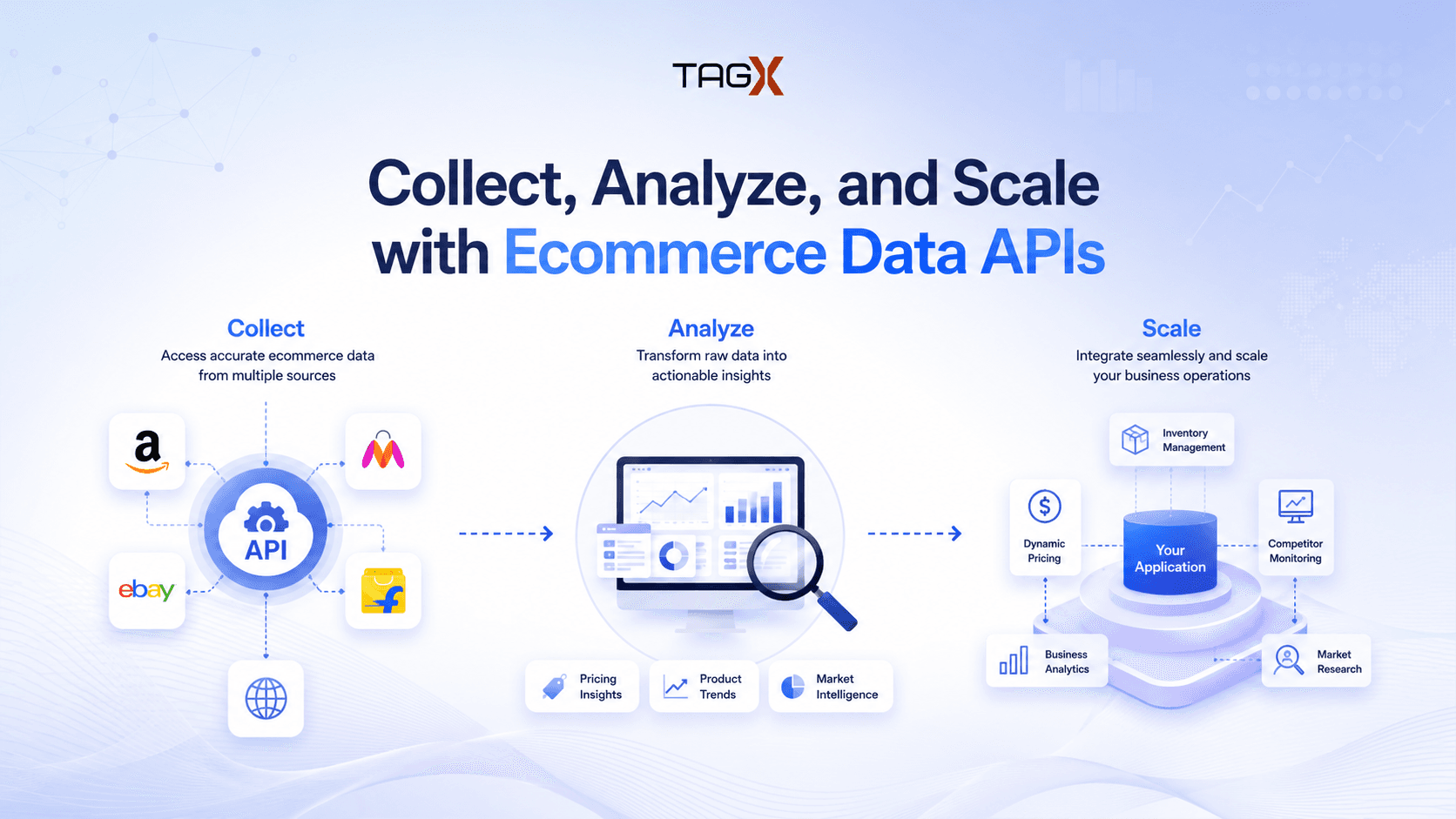
The Ecommerce Industry evolves every minute. Prices change, new products are launched, reviews influence buying decisions, and inventory shifts constantly.Businesses that rely on outdated information often struggle to stay competitive, while those with access to real-time data can react faster and make smarter decisions.
An Ecommerce Data API helps businesses access structured ecommerce data at scale, making it easier to track pricing, reviews, and product catalogs without manual effort.
For retailers, brands, marketplaces, and market research firms, ecommerce data APIs are an essential tool for staying competitive in a rapidly changing digital marketplace.
Understanding an E-commerce Data API
An Ecommerce Data API helps businesses access product information from online stores and marketplaces in a structured, automated way. Instead of manually reviewing hundreds of product pages, teams can request the data they need and receive it instantly in a machine-readable format.
Depending on the use case, the API can provide product titles, descriptions, current prices, discounts, inventory status, customer ratings, reviews, product images, brand information, and technical specifications. This gives businesses a complete view of products across multiple e-commerce platforms.
The data is typically delivered in formats such as JSON or CSV, or through REST-based APIs, making it easy to integrate with dashboards, internal systems, business intelligence tools, and analytics platforms. This enables businesses to automate workflows and make faster, data-driven decisions.
Why Businesses Need Ecommerce Data at Scale
For businesses managing large product catalogues or operating across multiple marketplaces, manual tracking quickly becomes inefficient, error-prone, and impossible to scale.
As product counts grow and market conditions change more frequently, relying on spreadsheets or manual checks can lead to missed updates and inconsistent data.
Some of the key ways businesses use ecommerce data at scale include:
- Competitor Price Monitoring: Track competitor pricing across marketplaces.
- Market Trend Analysis: Identify demand trends and consumer preferences.
- Pricing Optimisation: Build data-driven pricing strategies.
- Product Assortment Analysis: Monitor product availability and assortment gaps.
- Customer Sentiment Analysis: Analyse reviews and ratings to gain customer insights.
- Business Intelligence: Turn ecommerce data into actionable business insights.
With automated data collection, teams save time and gain accurate, up-to-date insights for faster decision-making. It also gives businesses a clearer view of the market, helping them respond quickly to pricing changes, customer behaviour shifts, and new opportunities.
Key Features to Look for in an E-commerce Data API
Choosing the right ecommerce data API goes beyond data access. A reliable solution should deliver accurate, scalable, and structured information that supports your business objectives.
- Fresh & Timely Data Access updates product information, including prices, inventory, ratings, and reviews, as market conditions change.
- Broad Marketplace Coverage: CollectCollect data from multiple ecommerce platforms to gain a complete view of competitors and market trends.
- Clean, Structured Data Receive organised data that's easy to integrate into analytics platforms, dashboards, and business applications.
- Built to Scale: Handle millions of product records efficiently without compromising performance or reliability.
- Flexible Data Collection: Capture custom data fields that align with your specific industry, products, or business goals.
- Reliable API Performance: Ensure consistent data delivery and high availability for applications that depend on continuous e-commerce intelligence.
A feature-rich e-commerce data API helps businesses collect, analyse, and act on market data with confidence.
Industries That Benefit from Ecommerce Data APIs
E-commerce data is valuable across industries, helping organisations make smarter decisions with accurate market insights.
- Retail & Ecommerce Brands: Stay competitive by monitoring prices, product availability, and marketplace activity.
- Market Research Firms: Analyse consumer trends, pricing patterns, and category performance at scale.
- Price Comparison Platforms deliver accurate and up-to-date pricing information from multiple sellers.
- Brands & Manufacturers: Track reseller pricing, product listings, and marketplace visibility across channels.
- Business Intelligence Teams: combine e-commerce data with internal business metrics to uncover actionable insights and support strategic planning.
Across industries, businesses that use ecommerce data get a clearer view of market trends, customer behaviour, and competitive activity, so they can make faster, more informed decisions with confidence.
Why Automation Is Essential for Ecommerce Data Collection
Manual data collection may work for small projects, but it quickly becomes inefficient as data volumes grow. Gathering product details, pricing updates, or reviews by hand is slow, repetitive, and hard to scale.
Automated ecommerce data collection offers several advantages:
- Faster access to information so teams can respond quickly to market changes
- Higher data accuracy by reducing human error
- Less manual effort, freeing teams for higher-value work
- Scalable collection across large catalogues and multiple marketplaces
- Better operational efficiency through streamlined workflows
- Improved decision-making with timely, structured data
Automation helps teams spend less time collecting data and more time analysing it, keeping businesses agile in fast-moving ecommerce markets.
Conclusion
As ecommerce becomes increasingly competitive, access to reliable product data is no longer optional. Businesses need accurate pricing, customer reviews, and product feed information to make informed decisions, optimise operations, and respond quickly to market changes.
TagX provides scalable ecommerce data API solutions that deliver structured, high-quality ecommerce data tailored to your business needs. Whether you're tracking competitor pricing, analysing customer reviews, or managing large product catalogues, our data solutions help you access the insights you need quickly and reliably.
Ready to power your business with scalable ecommerce data? Contact TagX today to learn how our ecommerce data solutions can support your growth.