


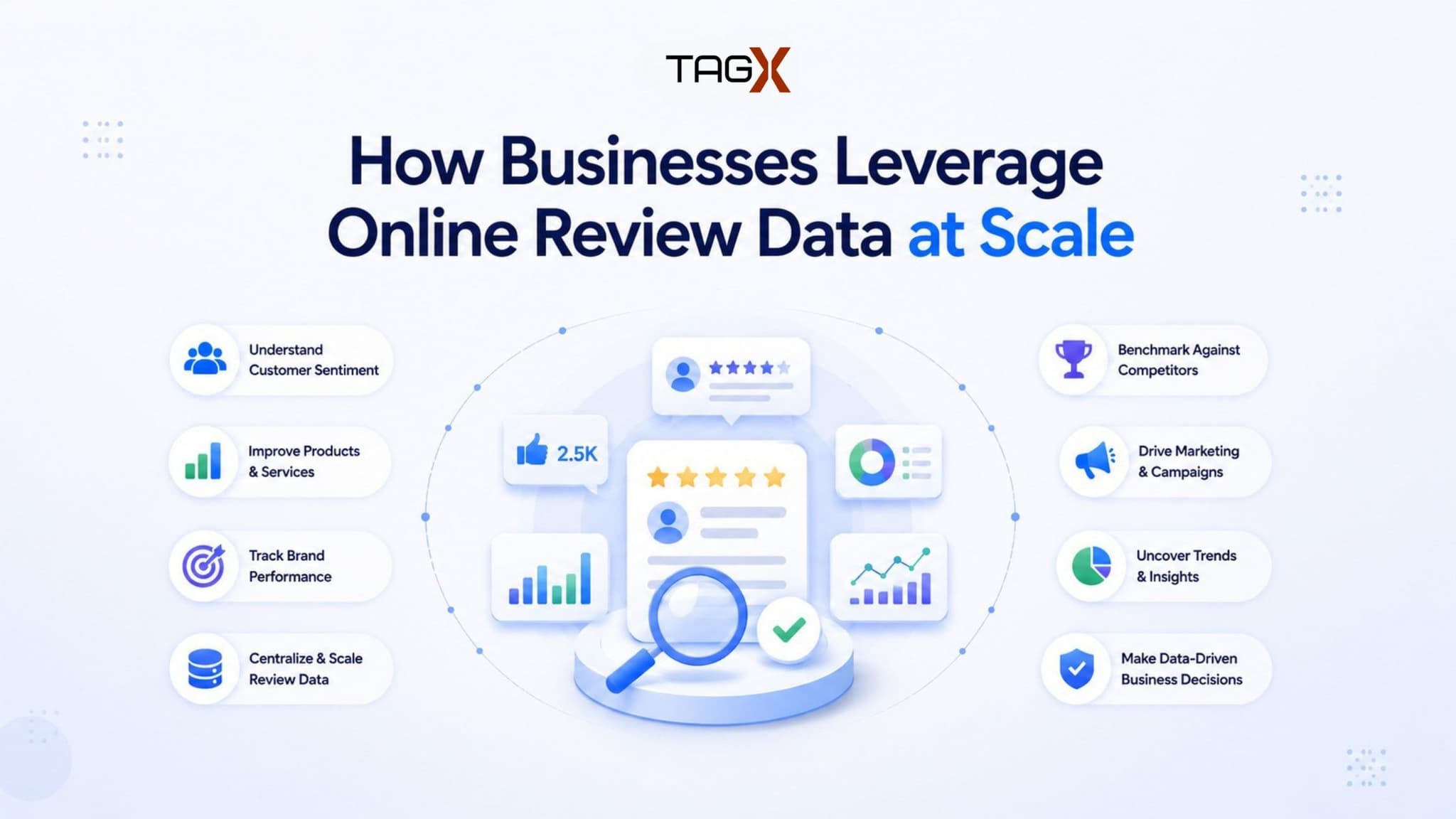
Amazon caps what's publicly visible. eBay doesn't even use star ratings. Yelp hides a quarter of its reviews from the record. Here's how brand tracking, market research, retail buying, and AI teams still pull clean, structured review data — text, ratings, reviewer signal, images, verification status — out of all three, and why the collection step is where these projects actually succeed or fail.
~1,000 Reviews publicly reachable per Amazon ASIN, regardless of how many exist
~25% Of submitted Yelp reviews get filtered out of the visible record
5–9% Revenue swing per one-star change in average rating
3 Structurally different rating systems across Amazon, eBay, and Yelp
The Problem: Review Data Looks Uniform. It Isn't.
Every platform displays reviews the same way on screen — a name, a star rating, some text. That visual consistency hides three genuinely different data models underneath, and it's exactly what makes review scraping harder than it looks.
Amazon exposes only the first ~100 pages of reviews per listing, no matter the real total, and runs a fingerprinting and behavioral anti-bot stack that tightens roughly every quarter.
eBay doesn't have "reviews" at all — it has an asymmetric feedback system where sellers can't leave buyers a negative, plus four anonymous Detailed Seller Ratings that don't even count toward the visible score.
Yelp filters out about a quarter of submitted reviews through a recommendation algorithm, and those filtered reviews don't factor into the star average customers actually see.
Teams that pull review data without accounting for any of this end up with datasets that look complete and aren't — missing volume, missing context, and in Yelp's case, missing an entire non-random tier of the record. That's the actual problem review scraping has to solve. It isn't extraction; it's building a pipeline that respects what each platform is really recording.
What a Structured Review Dataset Has to Capture
A usable pull isn't "reviews." It's a specific set of fields, preserved per platform rather than flattened into one generic shape:
- Full review text — including content Amazon loads only on interaction behind a "read more" toggle, which basic scrapers routinely skip
- Rating on its native scale — an Amazon star, a Yelp star, and an eBay DSR star measure different things and shouldn't be merged without that context
- Reviewer signal — Vine status, Yelp Elite badge and history, eBay account age — the main lever for filtering low-credibility feedback
- Timestamp, at the finest grain available — needed to catch a 72-hour complaint spike that a monthly aggregate would smooth over completely
- Verification status — verified purchase, recommended/not-recommended, transaction-linked feedback — each platform's version of "this reviewer actually transacted"
- Helpful votes and DSR sub-scores — a relevance-weighting layer most downstream teams reuse rather than rebuild
- Review images — often more diagnostic than the text for fit, damage, or quality complaints
- Product or listing metadata — ASIN/variant, business category and location, listing ID — without which a review can't be joined to anything
- Aggregate counts at time of pull — total volume and current average, used as a checksum against what the individual scrape actually returned.
How It Works — The Review Scraping Pipeline
- Scoped collection. Requests are routed per platform, per marketplace, per listing — because Amazon reviews don't merge across country domains, and pulling "the same product" globally means running the collection separately for each one.
- Anti-bot handling. Residential IP rotation, headless browser sessions that pass fingerprint checks, and randomized request timing — built to survive Amazon's quarterly tightening rather than break on the next update.
- Platform-native parsing. Each platform's fields get extracted in their own shape — eBay's feedback percentage and DSR breakdown, Yelp's recommended and filtered tiers, Amazon's verified-purchase flag — instead of being force-fit into one shared schema.
- Completeness checks. The pull is checked against the platform's own displayed total review count and average rating; a mismatch flags an incomplete scrape before it reaches anyone downstream.
- Structured delivery. Clean, tagged records — by platform, product, timestamp, and verification status — land in whatever format the consuming team needs: a warehouse table, a feed, or a flat file.
Who Actually Uses the Output
🎯 Brand Tracking Runs the feed on a tight refresh cycle to catch rating and complaint-volume shifts within hours, not weeks.
🤖 AI / ML Training Uses the corpus for sentiment and instruction-tuning work, relying on verification flags to down-weight low-credibility text.
📊 Market Research Firms Needs a complete sample for a defined window — a partial or biased pull undermines the credibility of the whole study.
🛒 Retail Buying & Assortment Checks review depth and verified-purchase ratio, not just the star average, before committing shelf space to a SKU.
🕵️ Competitive Intelligence Watches a rival's review velocity as an early signal of a promotion or a quality issue, often before it shows up in market share.
🔍 Product Research Mines unprompted feature requests, complaints, and review images for input customers never gave in a survey.
Before vs. After: Ad Hoc Pulls vs. a Real Collection Layer
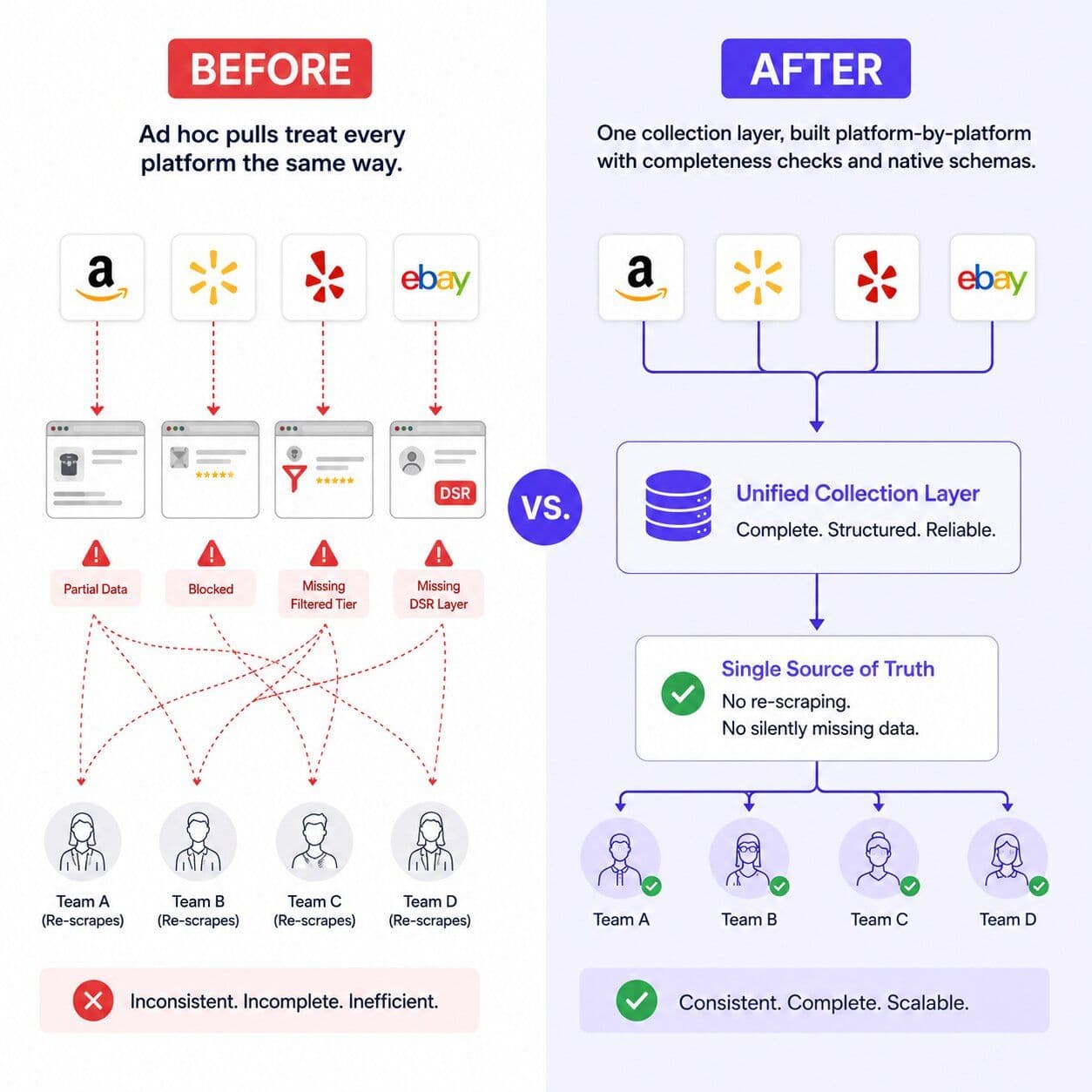
Before:
- Treats every platform the same way
- Caps out at whatever the page renders
- Gets blocked or CAPTCHA'd at volume
- Drops Yelp's filtered tier and eBay's DSRs
- Every team re-scrapes it their own way
After:
- One collection layer, per platform
- Checked against each platform's true totals
- Native schemas preserved, not flattened
- One dataset feeds every downstream team
- No re-scraping, no missing quarter
The Right Fit — and When It Isn't
This kind of infrastructure earns its cost for teams tracking review data continuously, across multiple platforms, at a volume where manual checking has already broken down — brand and competitive tracking, ongoing market research panels, retail assortment decisions refreshed regularly, and any AI training pipeline that needs a large, labeled corpus.
It's overkill for a single product on a single platform checked occasionally — that's a manual spot-check, not a pipeline. And no scraped dataset, however clean, replaces a proper legal read on a given platform's terms of service for the specific use case; that's a separate check every team running this at scale needs to do on its own.
Build It In-House, or Get It From a Specialist
Everything above is buildable in-house — plenty of teams do, especially once review data becomes core to a recurring decision like assortment or brand tracking. But the honest tradeoff is that this collection layer is never a one-time build. It's ongoing maintenance:
- Watching Amazon's anti-bot posture shift quarter to quarter
- Keeping eBay's DSR fields and Yelp's filtered tier intact instead of flattening them
- Re-validating completeness checks every time a platform changes its page structure
For a lot of teams, that maintenance load is exactly why they hand the collection layer to a provider that already runs it at scale, and just consume the structured output.
That's the gap TagX is built for — a managed pipeline for review and customer feedback data across Amazon, eBay, Yelp, and other marketplaces: full review text, native ratings, reviewer signal, verification flags, images, and product metadata, delivered on a schedule.
Talk to TagX about a sample dataset for your category before committing engineering time to building this yourself.