


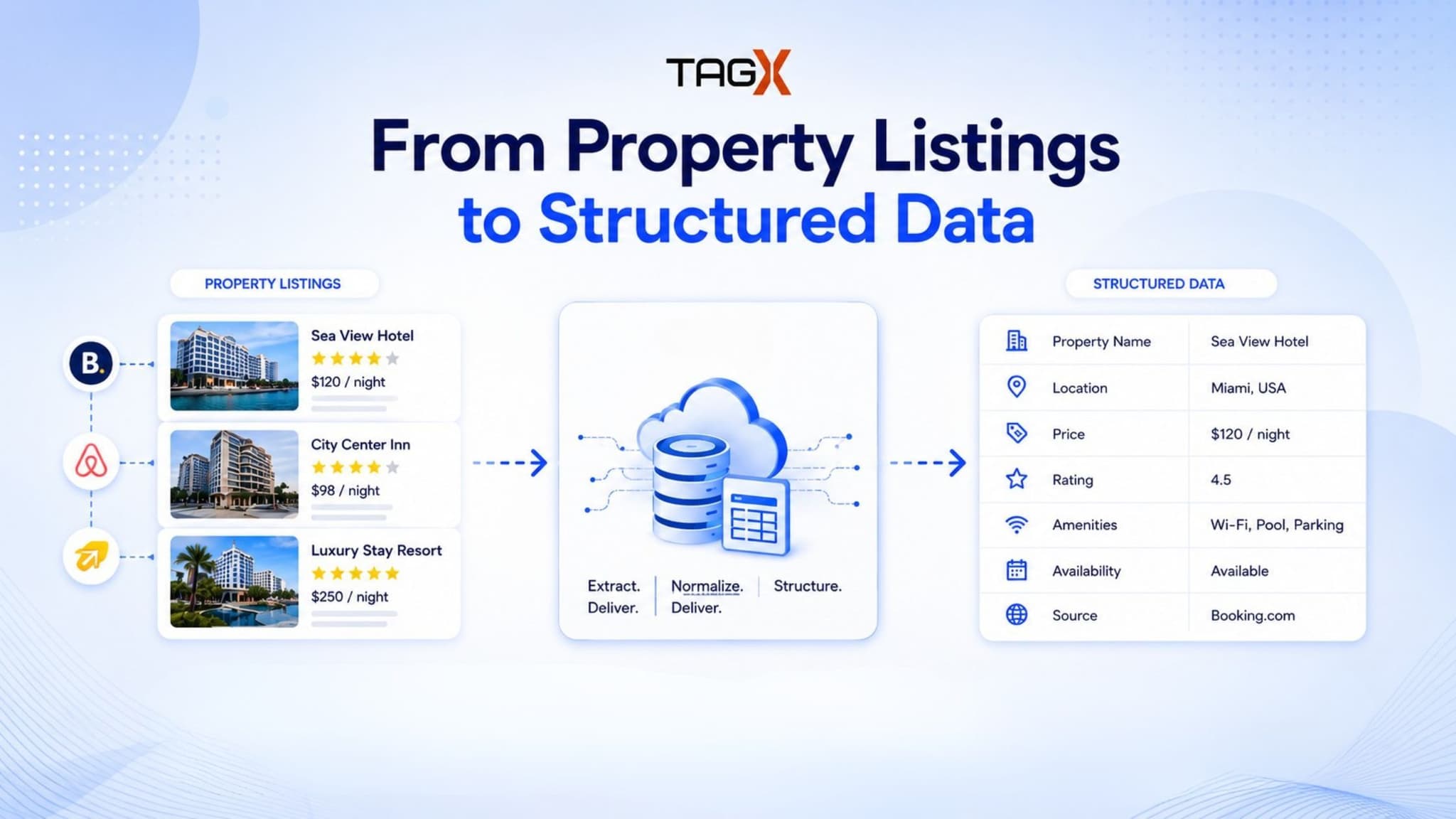
Real estate websites contain a huge amount of property information, from prices and addresses to floor plans, amenities, agent details, and listing status. The challenge is that this information is usually spread across thousands of individual pages and presented differently from one source to another.
For businesses that need property data at scale, manually collecting these details is not practical. Real estate scraping provides a way to systematically collect listings and convert them into structured property records.
But scraping a few property pages is very different from building a reliable property data collection process. Listings may be spread across hundreds of pages, some information may load dynamically, and the same attribute can appear in different formats across websites.
This guide walks through how property listing data can be collected, processed, and structured for practical use.
Planning Considerations
Before extracting anything, establish a clear collection plan. Real estate scraping works better when you know which listings you need, where they will come from, and what the final data should look like.
A typical workflow looks like:
Identify sources → Define fields → Find listing pages → Extract data → Handle pagination → Process dynamic pages → Normalize → Validate → Deliver structured data
A few things should be decided upfront:
- Target sources: Identify the property portals, agency websites, developer sites, or rental platforms containing the required listings.
- Property scope: Decide whether you need residential, commercial, rental, new-build, or specific property types.
- Geographic coverage: Define the cities, regions, or postal areas to collect.
- Required fields: Determine which attributes matter, such as price, location, bedrooms, area, amenities, and listing status.
- Update frequency: Decide whether the data is needed once or needs regular refreshes.
- Output structure: Establish how each property record should be organized so listings from different sources can be compared.
This planning stage is important because collecting more listings does not necessarily mean collecting better data. Without defined fields and coverage, missing or inconsistent information can be difficult to identify later.
Step 1: Identify the Property Listing Sources
The first step is deciding where the property data will come from.
Depending on the use case, sources may include:
- Property marketplaces
- Real estate agency websites
- Developer websites
- Rental platforms
- Commercial property portals
- Local property directories
Different sources organize listings differently. One website may display property details directly in the page HTML, while another may load information after the page opens.
Before collection begins, define:
- Which websites need to be monitored
- Which property types are relevant
- Which locations should be covered
- Whether sale, rental, or both listings are required
- How frequently the data needs to be refreshed
This keeps the collection focused on the properties that are actually useful to the business.
Step 2: Define the Property Fields to Extract
Once the sources are identified, decide what information each property record should contain.
A typical listing can include:
| Category | Example fields |
|---|---|
| Property | Title, property type, listing ID, URL |
| Pricing | Sale price, rent, price per sq. ft., currency |
| Location | Address, city, state, ZIP/postal code |
| Specifications | Bedrooms, bathrooms, area, floor, year built |
| Features | Amenities, parking, furnishing, balcony |
| Listing | Status, listed date, updated date |
| Agent | Agent name, agency, broker |
The required fields depend on the use case.
A property discovery platform may prioritize price, location, property type, and specifications. A market research business may also need listing history, price changes, and status updates.
Defining the schema before extraction makes it easier to standardize information later.
Step 3: Find and Extract Individual Listings
After defining the fields, the scraper can begin collecting individual property records.
A basic workflow is:
Search/listing page → Property URL or ID → Property details → Structured record
For each listing, the process identifies the relevant page elements and maps them to predefined fields.
For example:
Property ID: P123456
Property Title: 3-Bedroom Apartment
Price: $450,000
City: Austin
Bedrooms: 3
Bathrooms: 2
Area: 1,850 sq. ft.
Property Type: Apartment
Status: For Sale
The goal is not simply to copy everything visible on a page. Each value should be mapped to a consistent field so that thousands of properties can be processed in the same structure.
Where available, listing IDs and property URLs are also useful for identifying individual records and tracking them across subsequent collection runs.
Step 4: Handle Pagination and Large Listing Volumes
Real estate websites rarely display every available property on a single page.
Search results may be divided into numbered pages, "next" links, infinite scrolling, or "load more" interfaces.
For example:
Page 1 → Listings 1–20
Page 2 → Listings 21–40
Page 3 → Listings 41–60
...
The collection process needs to reliably discover and process these additional listings.
Depending on the website, this may involve:
- Following numbered pagination
- Detecting the next-page URL
- Processing page parameters
- Handling "load more" actions
- Capturing listings loaded through scrolling
Pagination is a common source of incomplete property data. A scraper may successfully collect the first 20 listings while silently missing thousands of others.
For this reason, it is useful to track page counts, listing counts, and unique property IDs during collection. A sudden drop in the number of records can indicate that pagination or source-page behavior has changed.
Step 5: Handle Dynamic Property Pages
Many modern property websites rely on JavaScript to load information.
The initial page response may contain only part of the listing. Additional details such as amenities, availability, images, maps, or specifications may appear after the page is rendered.
A basic HTML-only approach can therefore return an incomplete record.
Depending on how the website is built, relevant information may come from:
- Server-rendered HTML
- Embedded page data
- Structured metadata
- Network/API responses
- Browser-rendered content
The extraction method should match the source's technical structure.
The important point is to verify that the fields required for the property dataset are actually present in the collected output, rather than assuming that a successful page request means the entire listing was captured.
Step 6: Capture Listing Status and Changes
Property availability can change quickly.
A listing may move from:
For Sale → Under Offer → Sold
or:
Available → Rented → Unavailable
If only the current property details are collected, it becomes difficult to understand these changes over time.
For recurring collection, businesses can compare new records with previous records to identify:
- New listings
- Removed listings
- Price changes
- Status changes
- Updated property details
- Previously unavailable properties becoming active again
Capturing status and timestamps therefore makes the property data more useful for ongoing monitoring rather than treating each scrape as an isolated collection.
Step 7: Normalize the Collected Data
Collecting property information is only part of the process.
Different websites can represent the same information in completely different ways.
For example:
1,500 sq ft
1500 sqft
1,500 square feet
These values represent the same measurement but are not immediately comparable.
Similar inconsistencies can appear in:
- Currency
- Property types
- Location names
- Area measurements
- Bedroom and bathroom counts
- Date formats
- Listing statuses
Normalization converts these variations into consistent values.
| Raw value | Standardized value |
|---|---|
| 1,500 sq ft | 1500 sq ft |
| $450K | 450000 USD |
| 3 BR | 3 bedrooms |
| Apt. | Apartment |
This becomes particularly important when combining property listings from several websites.
Step 8: Validate the Property Records
A scraper can successfully collect webpages while still producing incomplete or inaccurate records.
Validation helps identify problems before the data is used downstream.
Useful checks include:
- Are listing IDs or URLs present?
- Are prices stored consistently?
- Are required location fields populated?
- Are area measurements valid?
- Are duplicate properties present?
- Are important fields missing?
- Were all expected listing pages processed?
- Has the source website changed its structure?
For recurring scraping, these checks can also reveal silent data loss.
What a Structured Property Record Looks Like
After extraction, normalization, and validation, a property can be represented as a structured record:
{
"property_id": "P123456",
"title": "3-Bedroom Apartment",
"property_type": "Apartment",
"price": 450000,
"currency": "USD",
"city": "Austin",
"bedrooms": 3,
"bathrooms": 2,
"area_sqft": 1850,
"amenities": ["Parking", "Balcony", "Gym"],
"status": "For Sale",
"listing_url": "...",
"listed_date": "2026-08-10"
}
The final format can vary depending on how the information will be used. Property data can be delivered through structured files, databases, or APIs.
What matters is that every listing follows a consistent structure.
Why Real Estate Scraping Is More Than Collecting Listings
Scraping property pages is only the starting point. Listings can span hundreds of pages, load dynamically, change over time, and use different formats across sources.
A reliable real estate scraping workflow therefore covers:
Source discovery → Extraction → Pagination → Structuring → Normalization → Validation → Updates
The goal is not just to collect listings, but to turn them into consistent, complete, and usable property data for market research, pricing intelligence, property discovery, and other applications.
Need Real Estate Data Without the Scraping Complexity?
Collecting property listings at scale is challenging—websites constantly change layouts, data is often unstructured, and handling pagination or dynamic content can quickly become complex and time-consuming.
TagX simplifies real estate data collection by delivering clean, structured, and reliable property data from online sources. We extract and organize key listing details such as pricing, location, property features, amenities, and availability status.
Turn raw listings into actionable insights with data that’s ready to use for market analysis, pricing intelligence, investment research, property discovery, and lead generation.