

A supplier clears screening in January.
In March, a regulator opens an inquiry.
In May, the CEO resigns.
In August, a local paper reports unpaid salaries at one of its plants.
The company's name never changed. Its risk profile changed four times.
This is the weak spot in most due diligence. A report is accurate on the day it is signed off, and then it starts to age.
The real question isn't "What do we know about this company?"
It is "What has changed since we last looked?"
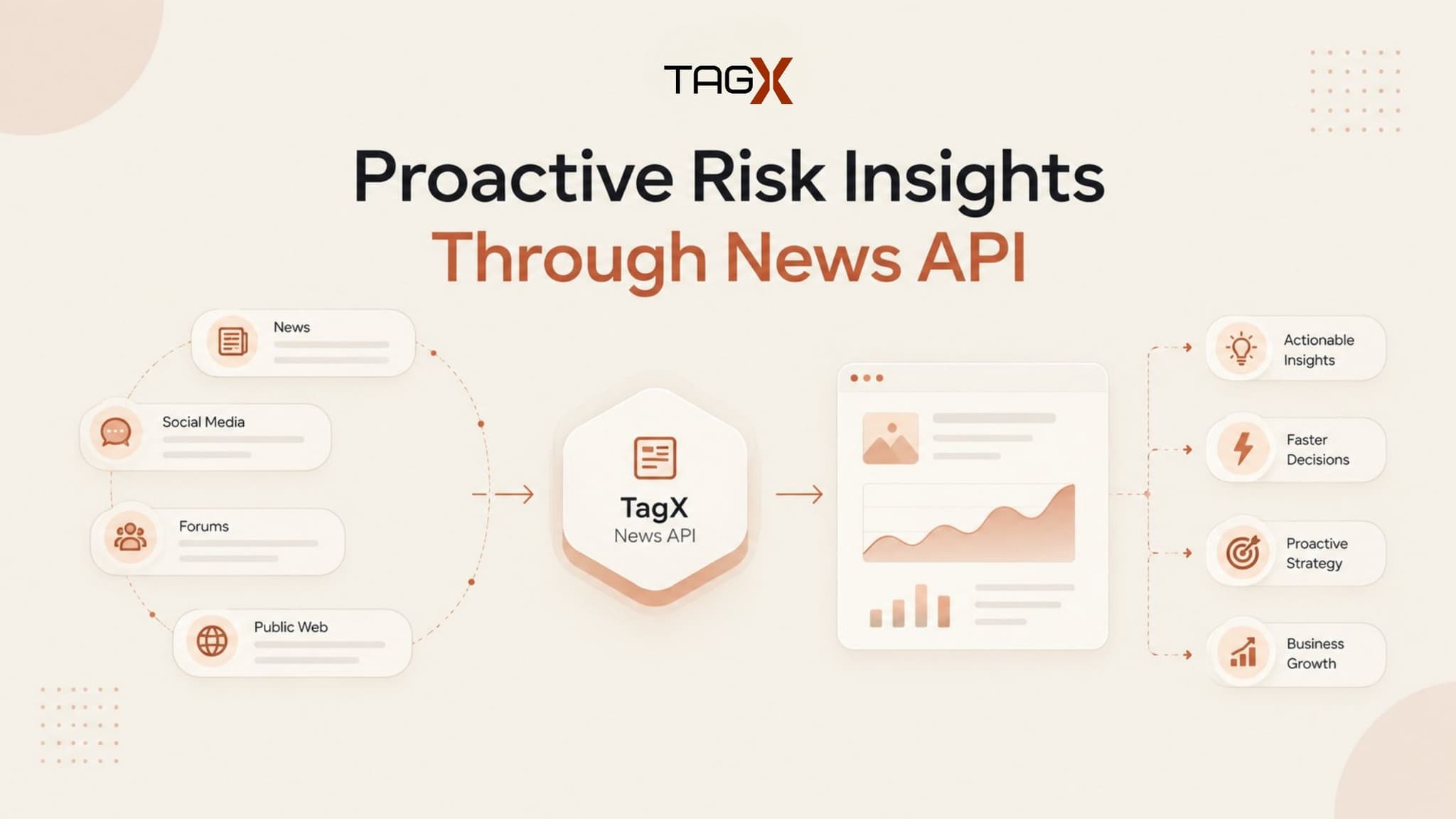
A News API helps answer that. It turns the constant flow of global news into structured data that your monitoring systems can use.
Why One-Time Checks Leave You Exposed
Most due diligence is tied to a milestone, such as onboarding a vendor, signing a partner, backing an investment or renewing a contract. At each point, someone searches, reads and documents. Then the report is filed, and nobody is watching.
This creates three problems:
- Manual searches don't scale - Checking hundreds of publications for thousands of entities isn't realistic.
- Quality varies - Different analysts use different keywords and read different sources.
- Reviews go stale - A clean report from last quarter says little about this week.
Regulators are also moving toward continuous oversight. AML standards expect ongoing due diligence throughout a business relationship, and third-party risk guidance expects vendors to be monitored for compliance lapses and financial trouble.
News is often where change shows up first. A local paper may report a labor dispute months before national media does, and a regulator's press release can appear before a company registry is updated.
Turning Raw News Into Structured Data
A News API gives programmatic access to articles from many publishers. Instead of web pages, it returns structured records that software can read and filter.
A typical record can include:
- Headline and article text
- Publication date and time
- Publisher, domain and URL
- Language and country
- People, organizations and locations mentioned
- Topics, categories or sentiment scores
- Duplicate or syndication indicators
Because the data is machine-readable, it can leave the browser and flow straight into your own systems.
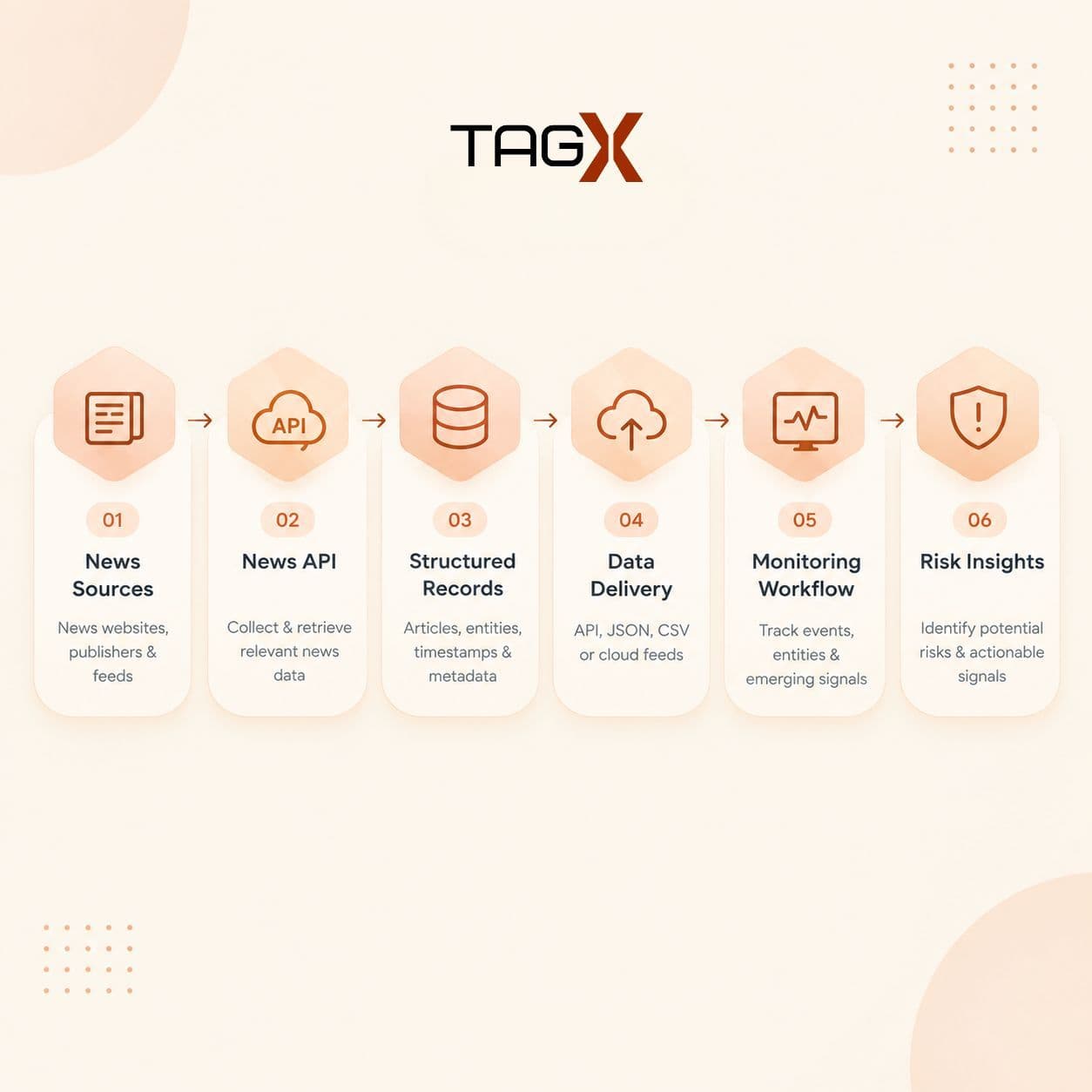
The API collects and structures the information. Your analysts, rules engines or AI models decide what it means.
Stop Counting Articles, Start Tracking Events
Here is the most important design choice in a news-driven risk system: what is the basic unit of information?
Most basic setups think in articles. A name matches, a keyword hits and an alert fires. But when one story is republished by fifty outlets, the analyst gets fifty alerts, and a scoring model may read that volume as fifty separate negative findings.
An event-based approach treats the incident as the main object and the articles as evidence attached to it.
| Approach | What It Tracks | Typical Result |
|---|---|---|
| Article-based | Each individual mention | Repeated alerts, duplicate review work |
| Event-based | One incident and its supporting coverage | Fewer, clearer alerts with context |
Risk events can evolve over time, making it important to track how a situation develops rather than treating every new article as a separate alert.
Following these changes helps teams understand whether an issue is still an allegation, has moved into an investigation, or has progressed toward formal action or resolution.
Source diversity also adds important context to risk monitoring. Coverage from several independent and credible outlets can provide stronger evidence and a more complete view of an event, while multiple articles repeating the same original report may add little new information.
Which News Signals Actually Point to Risk
Not every mention of a company is a risk. The value comes from spotting developments that change the context around an entity.
Common signals include:
- Regulatory: investigations, fines, warnings, license actions
- Legal: lawsuits, settlements, court rulings, disputes
- Fraud and misconduct: bribery, corruption, financial wrongdoing allegations
- Leadership: executive exits, board changes, controversies
- Financial: restructuring, missed payments, layoffs, insolvency
- Operational: recalls, safety incidents, plant shutdowns, supply disruptions
- Cyber: breaches, ransomware, service outages
- Reputational: sustained negative coverage of a brand or executive
Sentiment can help narrow the volume, but it is only one input. A neutral regulator notice can matter far more than an angry opinion column, and an article about a successful appeal may carry harsh language from the original case while signaling lower risk.
Reliable signals combine several factors:
- Entity match
- Event type and stage
- Source quality
- Recency
- Sentiment
The Past Explains the Present
Current news tells you what is happening. Historical news explains how the situation got there and whether the latest development is part of a larger pattern.
For example, if a regulator opens an investigation into a supplier, past coverage can show whether:
- Similar concerns were raised before
- The issue has been building for months
- Earlier allegations were disputed or withdrawn
- This is a first incident or a recurring issue
- The situation is escalating or moving toward resolution
This context helps teams interpret new developments more accurately instead of treating every article as an isolated event.
It also guards against a common monitoring problem: a system can keep accumulating negative coverage while missing later developments that provide important context. Without historical and ongoing updates, old allegations may continue to dominate the risk picture even after an issue has been
You Can't Flag What You Can't See
A classifier can only evaluate what reaches it. A well-tuned model sitting on a narrow set of sources can still miss the story that matters.
Broad coverage helps in three ways:
- Regional sources often report local issues, such as labor disputes or safety complaints, before national media does.
- Industry publications add sector detail that general news skips.
- Multilingual coverage closes blind spots in markets where your suppliers and partners actually operate.
Freshness matters just as much. A six-month-old article may supply background, while one published this morning may signal a real turning point. Proactive due diligence needs both.
A Step-by-Step Monitoring Workflow
A News API doesn't replace your compliance or risk platform. It feeds it.
A practical workflow looks like this:
- Define the entities: List companies, suppliers, executives, targets and owners, with aliases, former names and subsidiaries.
- Set search parameters: Use names, keywords, locations, dates, sources and topics.
- Collect the data: Retrieve articles and metadata on a schedule or as a stream.
- Match to the right entity: Make sure "Apex Holdings" in the article is your Apex Holdings, using location, industry and executive names as extra identifiers.
- Filter and deduplicate: Remove irrelevant content and group repeated coverage into events.
- Compare with history: Decide whether the development is new or part of an existing story.
- Deliver the data: Push records into databases, dashboards, case tools or AI pipelines through a Data API or other structured delivery method.
- Review and act: Analysts or rules decide whether to escalate, update a score or request deeper checks.
- Feed back: Use analyst decisions to refine queries and thresholds over time.
The division of labor is simple. The News API supplies information, and the downstream workflow turns it into decisions.
How to Choose the Right News API Provider
Don't judge a provider by article count alone. For risk work, what matters is fit with your entities, regions and systems.
| Requirement | What to Evaluate |
|---|---|
| Source coverage | Publications, regions, industries and languages |
| Freshness | How quickly new articles become available |
| Historical depth | How far back you can retrieve coverage |
| Search controls | Filtering by entity, keyword, date, location, source |
| Data format | JSON or other machine-readable delivery |
| Scalability | Number of entities and requests supported |
| Integration | Compatibility with your databases, apps and AI workflows |
| Customization | Ability to add specific sources or fields |
Mistakes to Avoid Before You Scale
- Name collisions: common names create noise, so invest in entity matching.
- Alert fatigue: cluster events and prioritize by severity.
- Unverified sources: look for corroboration before escalating serious claims.
- Over-automation: keep humans in the loop and document decisions for audit.
- Data governance: check licensing terms and privacy rules for storing and processing news data.
From Periodic Checks to Continuous Awareness
Due diligence is no longer only about what a company looked like when it was first screened. New events can change the picture at any time.
A News API lets businesses collect those developments continuously. Historical coverage shows how an issue evolved, and structured delivery moves the information into the systems where decisions happen.
The outcome isn't an automated verdict. It is a current, structured data foundation that keeps due diligence connected to what is happening now.
TagX provides structured news and web data through API-based and customized collection workflows. We help teams feed relevant data into their applications, databases, research systems and AI pipelines.
Need structured news data for continuous monitoring and due diligence? Talk to TagX.