


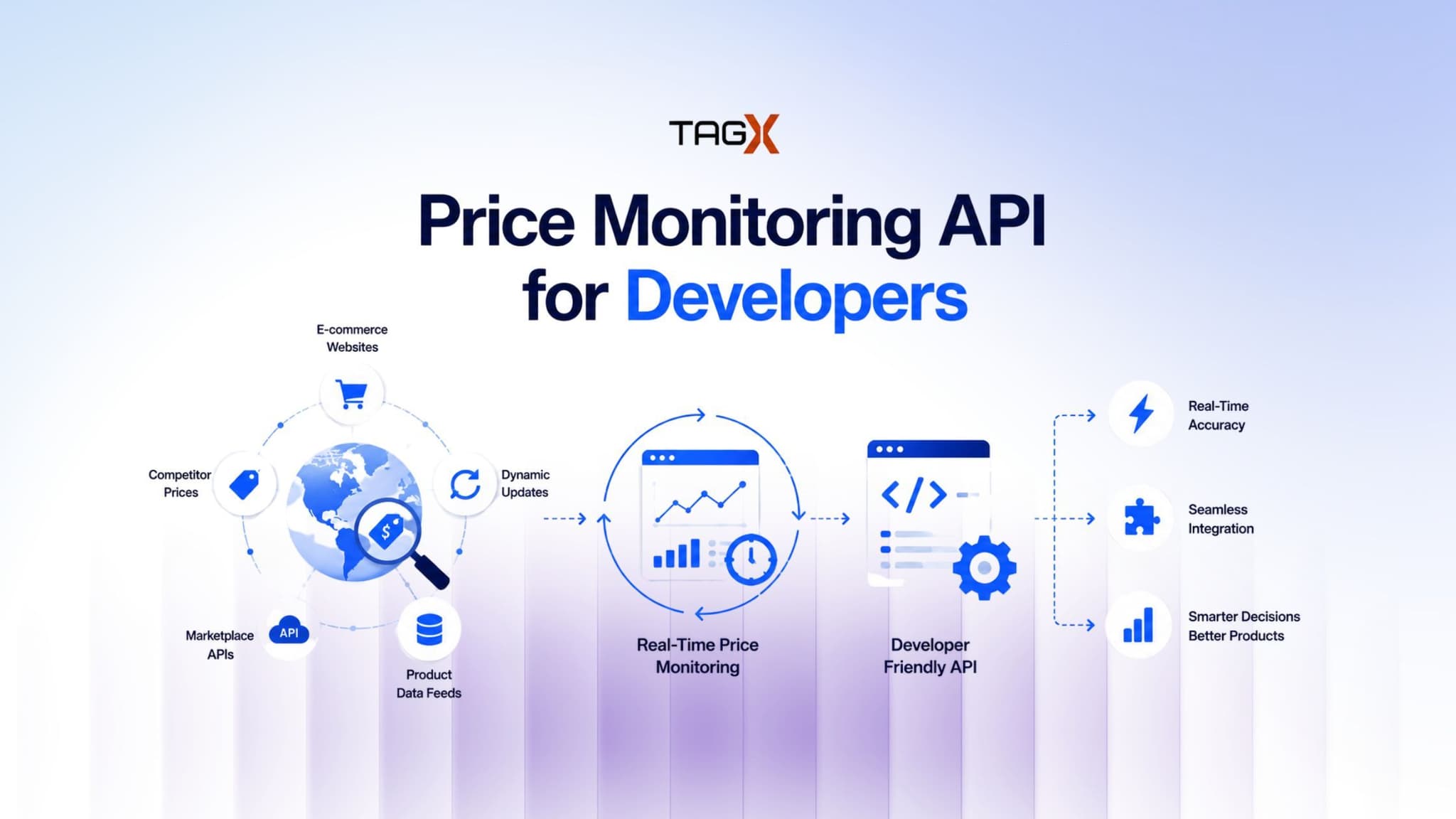
Keeping up with competitor prices has become essential for retailers in today's fast-moving market. Real-Time Price Monitoring makes it easier to track pricing changes, respond to market trends, and make informed business decisions.
Instead of manually checking multiple websites, developers can use a Price Monitoring API to access reliable pricing data in a structured format.
From retail analytics and dynamic pricing to Pricing Automation, these APIs help build smarter, more efficient pricing solutions.
In this guide, we'll cover everything you need to know about price monitoring APIs, including how they work, their key features, common challenges, and real-world use cases.
What is a Price Monitoring API?
A Price Monitoring API is a service that collects, processes, and delivers product pricing information from online sources in a structured format.
Most modern APIs rely on a robust web scraping API infrastructure behind the scenes to extract publicly available product information from eCommerce websites, marketplaces, retailer catalogs, and other online sources.
The extracted data is then cleaned, standardized, and delivered in developer-friendly formats such as JSON or CSV.
This allows organizations to build applications that support:
- Competitor price monitoring
- Dynamic pricing engines
- Product comparison platforms
- Retail analytics dashboards
- Pricing Automation workflows
For developers, APIs eliminate the need to build and maintain large-scale web scraping systems from scratch.
Why Do Businesses Need a Price Monitoring API?
Markets change continuously. Prices fluctuate due to promotions, inventory changes, seasonal demand, competitor activity, and regional strategies.
A Price Monitoring API helps businesses react faster by providing timely pricing updates.
Common business benefits include:
- Monitor competitor pricing automatically.
- Detects price changes in near real time.
- Improve pricing strategies using Market Intelligence.
- Support dynamic pricing models
- Reduce manual research
- Improve profit margins
Businesses that rely on spreadsheets or manual monitoring often struggle to keep pace with rapidly changing online marketplaces. Automated APIs provide consistent, scalable access to pricing data that teams can trust.
Key Features to Look for in a Price Monitoring API
Not every API offers the same level of performance. Developers should evaluate several important capabilities before selecting a provider.
Real-Time Data Delivery
A reliable real-time data API should deliver up-to-date pricing information as market conditions change.
High Data Accuracy
Choose an API that provides clean, validated, and consistent pricing data for reliable decision-making.
Scalable API Performance
The API should efficiently handle growing product volumes without compromising speed or reliability.
Flexible API Data Integration
Easy API data integration ensures pricing data connects seamlessly with your existing business systems.
Broad Source Coverage
Look for an API that collects pricing data from multiple retailers, marketplaces, and public online sources.
Developer-Friendly Documentation
Well-structured documentation, SDKs, and sample code make implementation faster and easier.
Common Challenges in Automated Price Tracking
Automated price tracking is more complex than simply collecting product prices.
Developers commonly encounter several obstacles:
Website Structure Changes
Retail websites frequently update layouts, causing traditional scraping scripts to fail.
Anti-Bot Protection
Many websites implement rate limits, CAPTCHAs, and bot detection mechanisms that interrupt data collection.
Data Standardization
Different websites display pricing information using different formats, currencies, product variants, and naming conventions.
Large-Scale Monitoring
Tracking thousands of products across multiple websites requires scalable infrastructure.
Data Freshness
Outdated pricing data reduces the value of monitoring systems, especially for businesses using dynamic pricing strategies.
Managing these challenges internally often requires ongoing engineering effort and maintenance.
How a Price Monitoring API Solves These Challenges
A managed Price Monitoring API handles much of the complexity involved in automated price tracking.
Instead of maintaining scraping infrastructure, developers can access structured pricing data through simple API requests.
Modern solutions typically provide:
- Automated website adaptation
- Managed scraper maintenance
- Data validation and normalization
- Reliable update schedules
- Scalable infrastructure
- Consistent API responses
This allows engineering teams to focus on building products rather than maintaining data collection systems.
Businesses also benefit from improved reliability and reduced operational costs compared to managing custom scraping solutions internally.
Top Use Cases of a Price Monitoring API
Price monitoring data supports a wide range of business applications.
Competitor Price Monitoring – Help businesses monitor competitor pricing and quickly identify market changes.
Dynamic Pricing – Enable automated pricing decisions using accurate, real-time pricing data.
Retail Analytics – Turn pricing data into actionable insights for product and market analysis.
Marketplace Intelligence – Monitor marketplace pricing trends, promotions, and competitive activity.
Product Comparison Platforms – Display current product prices to improve the shopping experience.
Inventory Planning – Support inventory and purchasing decisions with reliable pricing insights.
Conclusion
As online markets become increasingly competitive, automated price tracking has shifted from a convenience to a business necessity.
A reliable Price Monitoring API helps developers build scalable applications while giving businesses access to accurate pricing insights, Market Price Intelligence, and efficient Pricing Automation without the complexity of maintaining large-scale scraping infrastructure.
At TagX, we provide Data as a Service (DaaS) solutions that deliver reliable, structured pricing data through scalable APIs. Whether you're building competitor monitoring tools, dynamic pricing systems, or retail intelligence platforms, our APIs help simplify data collection and integration.
Ready to automate your price monitoring? Discover how TagX can power your price monitoring.