


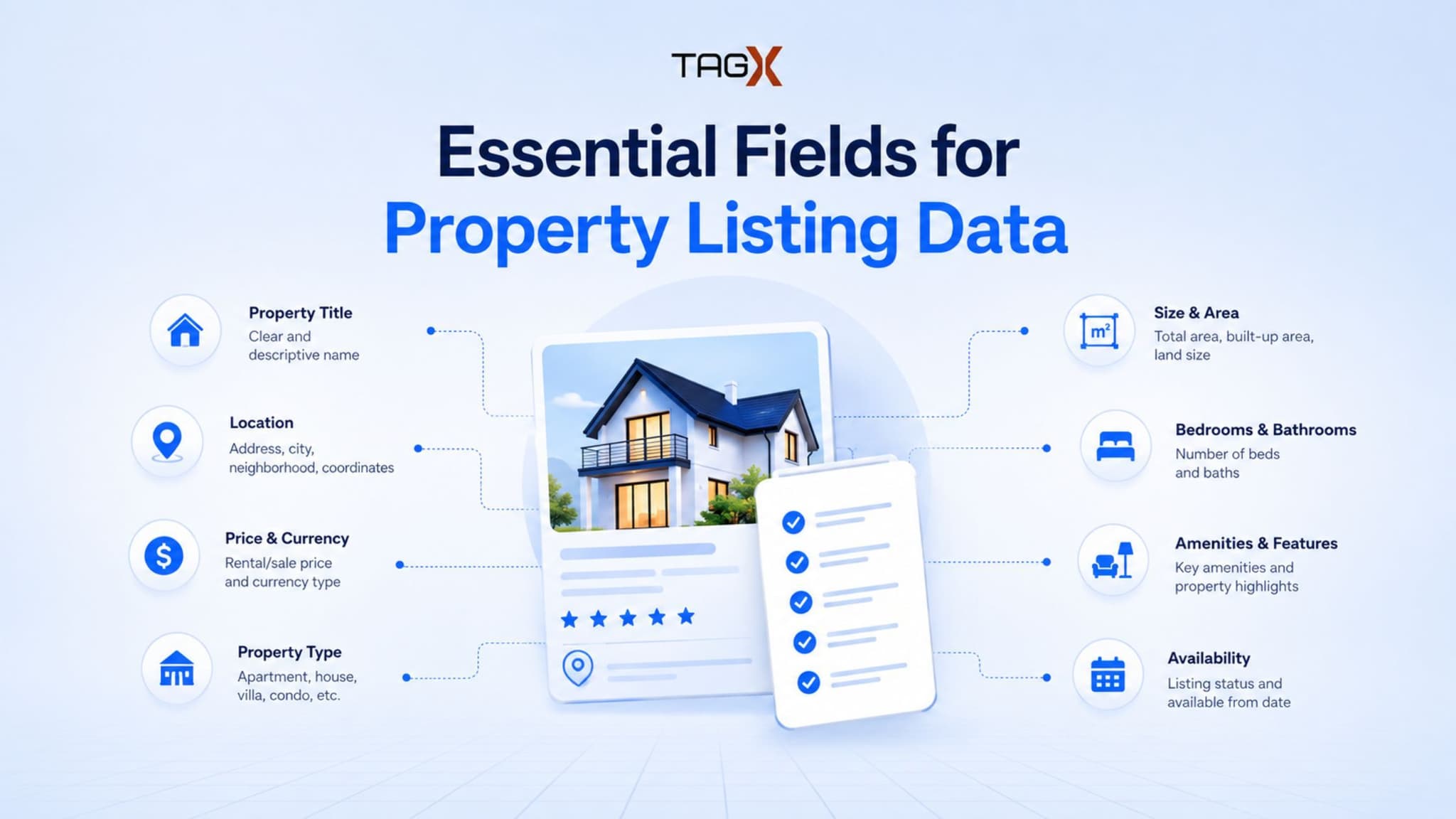
Property listings contain far more than a price and an address. A single listing can include identifiers, location details, specifications, amenities, images, agent information, availability, and a history of changes.
For businesses, the challenge is not simply collecting these details. It is creating property listing data with a consistent structure across multiple sources so properties can be compared, monitored, and analyzed reliably.
A standardized property dataset can support pricing intelligence, market research, portfolio analysis, and competitive monitoring. This guide breaks down the key fields a complete property dataset should contain and explains how standardization turns individual listings into useful market intelligence.
What Should Property Listing Data Include?
The exact schema depends on the business use case, but a strong property dataset generally covers these areas:
| Data category | Key fields |
|---|---|
| Identifiers | Listing ID, property ID, source URL |
| Address & location | Address, city, state, ZIP/postcode, neighborhood, latitude, longitude |
| Property details | Property type, listing type, bedrooms, bathrooms, size |
| Pricing | List price, price per sq. ft., currency |
| Features | Amenities, parking, furnishing |
| Media | Image URLs, floor plans, virtual tour URLs |
| Agent details | Agent name, agency, contact information |
| Listing status | Active, pending, sold, off-market |
| Timestamps | Listed date, updated date, collected date |
| Price history | Previous price, new price, change date |
The important part is not just capturing these fields. It is keeping them consistent across every source.
Identifiers: The Foundation for Every Record
Every listing needs a reliable way to be identified.
Common fields include:
- Listing ID
- Property ID
- Source or platform name
- Source URL
- MLS or platform reference number, where available
These identifiers help businesses distinguish between properties and detect duplicates when the same property is syndicated across multiple portals. A source-specific listing ID should generally be retained alongside an internal property ID, so a record can always be traced back to where it came from.
Address and Location: More Than a Street Name
Location is one of the most important components of a property record, since value and demand are heavily influenced by geography.
A complete location structure can include:
- Street address
- City
- State or province
- ZIP or postal code
- Neighborhood
- Latitude and longitude
Standardization matters here. One source might use "New York City," another "NYC," and another simply "New York." Without normalization, these can appear as different markets during analysis. Geocoded coordinates also support radius searches and neighborhood-level comparisons that address text alone can't.
Property Type and Core Specs: What's Actually Being Offered
The dataset should clearly describe what is being offered.
Useful fields include:
- Property type
- Listing type (for sale, for rent)
- Bedrooms and bathrooms, including half-baths
- Square footage and lot size
Property types should be mapped into standardized categories. "Condo," "condominium," and "apartment condo" may need to be grouped under a single category depending on the analysis, since different platforms often describe the same property type using different terminology.
Businesses that need to collect this information across property sites can use real estate web scraping to capture listings at scale while maintaining a consistent extraction structure. For a closer look at the collection side, How to Scrape Real Estate Listings From Popular Property Sites explains how listing information can be gathered from major property platforms.
Price and Pricing Metrics: List Price Is Only the Start
Price is usually the central field for property market analysis, but a useful pricing structure needs more than one number.
Important fields include:
- List price
- Currency
- Price per square foot or square meter
- HOA or maintenance fees
Currency and measurement units should be standardized before comparing properties from different markets. Comparing a property listed at $500,000 with another listed at ₹500,000 without currency normalization produces meaningless results, and the same issue applies to square feet versus square meters.
Size Details: Where Units Quietly Break Comparisons
Basic property specifications form the foundation of property comparison.
A typical schema should capture:
- Interior square footage
- Lot size
- Floor number and total floors, where applicable
The measurement unit should always be stored alongside the value. For example, 1,500 sq ft should not simply become 1,500. Keeping the unit makes the data easier to validate and prevents incorrect comparisons when sources use different measurement systems.
Amenities: Structured, Not Free-Text
Amenities add context to the headline specs.
Depending on property type, useful fields can include:
- Parking
- Pool
- HVAC or air conditioning
- Furnishing status
- Pet policy
These fields are often presented differently across listing sites. One source may list "covered parking," another "garage." Mapping these into a standardized taxonomy, rather than leaving them as free text, makes filtering and comparison possible at scale. This is especially useful for businesses operating in the real estate industry, where comparing properties across markets requires consistent definitions.
Images and Media: More Than Just Photo Links
Visual information is another valuable part of a property record.
A media structure can include:
- Primary image URL
- Additional image URLs
- Image count
- Floor plan or virtual tour URL
Rather than storing only the images themselves, businesses should preserve the relationship between each media asset and its listing. This makes the data more useful for property discovery, market research, and automated quality checks.
Agent and Brokerage Details: Who's Behind the Listing
Agent information helps identify who is responsible for a listing and supports market and competitive analysis.
Common fields include:
- Agent name
- Agency or brokerage
- Contact information, where appropriate
- Listing count associated with the agent
These fields can help businesses understand which agencies dominate particular markets or track changes in listing activity over time.
Listing Status: Is It Even Still Available
A property record is incomplete without knowing whether the listing is still available.
Useful status values include:
- Active
- Pending
- Sold
- Off-market
- Withdrawn
Status values should be standardized, since different platforms use different terminology for similar conditions. For businesses tracking inventory, this field matters most: a listing that was active last month but is now sold should not continue appearing as available in a current database.
Timestamps: Knowing When the Data Was True
Property data changes constantly, so timestamps are essential.
A robust dataset can include:
- Original listed date
- Last updated date
- Status change date
- Collection timestamp
The collection timestamp is particularly useful when businesses refresh listings regularly. It shows when a given version of the record was observed, making it possible to distinguish current information from historical observations rather than simply overwriting older records.
Price History: Where the Real Insight Lives
The current price tells only part of the story. Historical pricing reveals how a property has moved through the market.
A price history structure can contain:
- Previous price
- New price
- Percentage change
- Effective date
For example, a property might move from $650,000 to $625,000 and later to $599,000. Preserving each change helps businesses identify repeated reductions, pricing strategies, and shifts in seller behavior. Price history becomes even more valuable when combined with listing status, location, and time-based market data.
Why Standardization Matters Across Sources
Collecting all these fields is only half the job. Property platforms rarely use identical structures.
One source may report:
"3 Beds | 2 Baths | 1,800 Sq Ft"
Another may separate each value into individual fields. A third may use square meters instead of square feet.
Without normalization, combining these records creates inconsistent information that's difficult to analyze. A standardized schema solves this by mapping different source formats into common fields, so businesses can compare properties across portals, locations, and property categories using the same definitions. This also makes it easier to validate records, identify missing values, remove duplicates, and maintain consistency as the number of sources grows.
Turning Property Listings Into Market Intelligence
Once property listing data is standardized, businesses can use it for more than maintaining a property database. For example, they can:
- Compare asking prices across competing listings
- Track inventory by location and property type
- Identify properties with repeated price reductions
- Monitor new listings entering a market
- Analyze which amenities correlate with higher prices
- Identify changes in agent or agency activity
The underlying value comes from connecting individual fields. Price becomes more useful when combined with size, location, and historical changes. Listing status becomes more useful when paired with timestamps. Amenities become more useful when they can be compared consistently across thousands of properties. The broader business case for this kind of data is explored in 8 Reasons You Need Real Estate Data Scraping in 2026, particularly where property data supports market monitoring, competitive research, and decision-making.
What a Complete Property Dataset Looks Like
A complete property dataset should provide a consistent view of what the property is, where it is, how much it costs, what it offers, who is listing it, and how its status has changed over time.
The strongest datasets go beyond collecting whatever information happens to appear on a property page. They define a schema first, normalize values across sources, preserve historical changes, and maintain timestamps for freshness. That structure is what allows businesses to move from a collection of listings to a reliable source of pricing, inventory, and market intelligence.
For companies collecting listings across multiple property portals, real estate web scraping can provide the collection layer, while a well-defined data schema ensures the resulting information remains consistent and useful as coverage expands.
If you're scoping how many sources to pull from or how deep the field list needs to go, it's worth working through those decisions with a data team before the schema is locked in. You can get in touch with our team to talk through what a property dataset built for your use case should contain.