

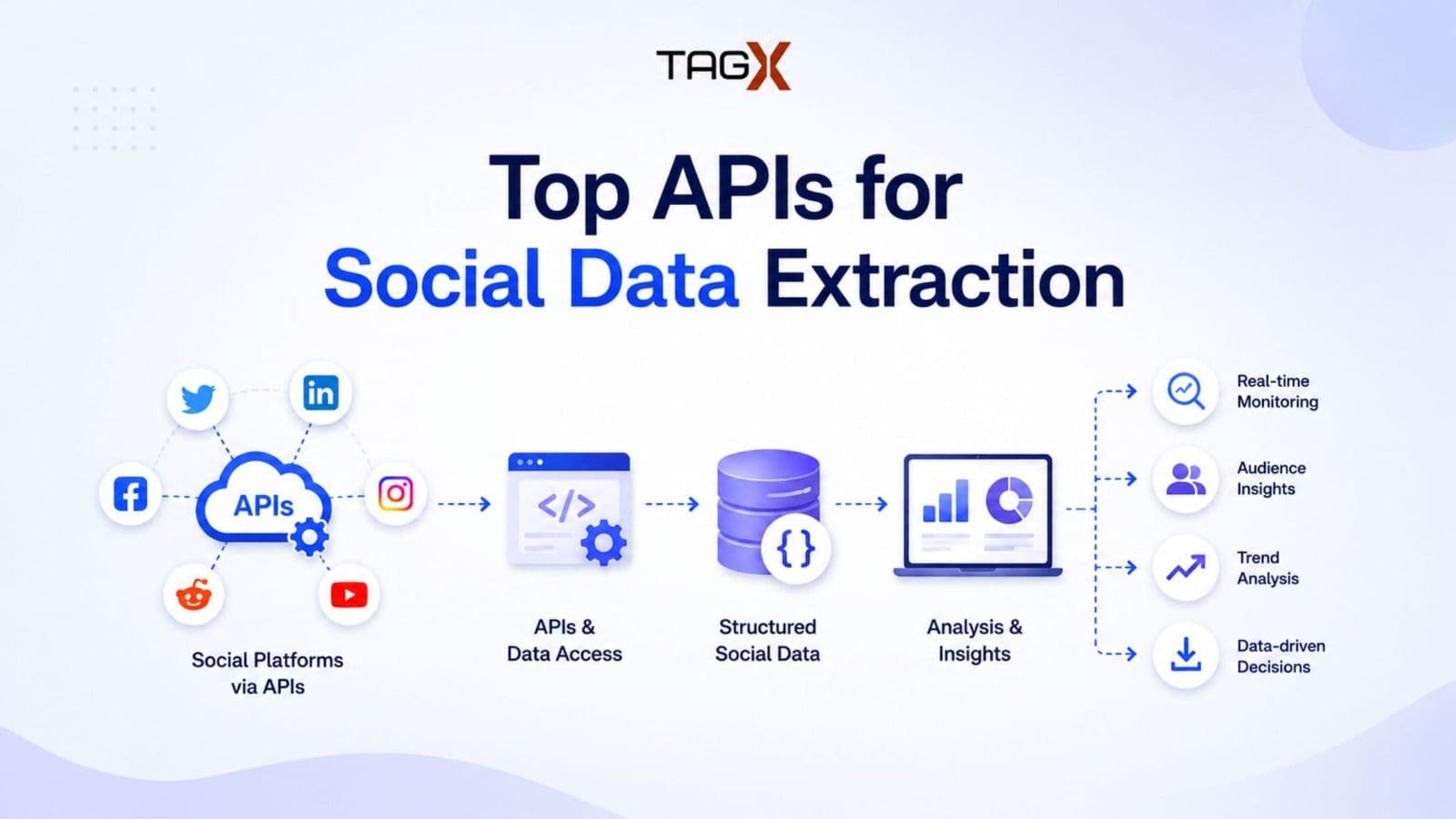
Social media data has become one of the most valuable sources of business intelligence available today.
Everyday, millions of public conversations, reviews, comments, and discussions reveal insights into customer preferences, emerging trends, brand perception, and market movements.
Businesses, researchers, and marketers increasingly rely on social media insights to understand customer behavior, monitor trends, and support decision-making.
However, collecting large volumes of public social media data manually can be time-consuming and difficult to scale.
This is where Web Scraping APIs play a critical role. By automating social media data extraction, businesses can access structured, real-time insights at scale.
Turning Social Conversations into Business Intelligence
Social platforms have become powerful channels where consumers share opinions, discuss products, and engage with brands.
These interactions provide valuable information that businesses can use to understand their markets more effectively.
By analyzing social discussions, businesses can gain a clearer understanding of how their brand is perceived and how competitors are engaging with their audiences.
Some common applications include:
- Brand monitoring and reputation management
- Market research and trend identification
- Customer sentiment analysis
- Audience engagement tracking
- Product feedback analysis
Organizations that leverage social media analytics can make faster, more informed decisions based on real-world customer conversations.
The Technology Behind Automated Social Data Collection
A Social Media Scraping API is a data collection API designed to automate the extraction of publicly available social media information. Instead of manually reviewing thousands of posts and discussions, businesses can use automated tools to gather relevant data efficiently.
A social media scraping API simplifies public social media data extraction by collecting and organizing information into structured formats that can be easily analyzed.
Common data types include:
- Public posts
- Comments and discussions
- Hashtags and trending topics
- User engagement metrics
- Public profiles
- Reviews and audience feedback
Compared to manual collection methods, automated web scraping services provide faster access to larger datasets while improving consistency and scalability.
Key Features to Look for in a Social Media Scraping API
Choosing the right solution is essential for maximizing the value of social media monitoring efforts.
Data Coverage
Collect data from multiple social sources for broader market visibility.
Data Accuracy
Access reliable, structured data for accurate analysis and decision-making.
Real-Time Updates
Monitor current conversations and emerging trends as they happen.
Scalability
Handle growing volumes of social media data efficiently.
Flexible Delivery
Receive data through APIs, databases, dashboards, or custom formats.
Compliance and Ethical Data Collection
Prioritize publicly available data and responsible collection practices.
Common Business Use Cases for Social Media Data Extraction
Businesses across industries use social media data extraction to support a wide range of strategic initiatives.
Brand Monitoring
Track brand mentions, customer discussions, and public sentiment to protect and strengthen brand reputation.
Competitor Analysis
Monitor competitor campaigns, audience engagement, and market positioning to identify opportunities and benchmark performance.
Customer Sentiment Analysis
Analyze public feedback to understand customer satisfaction levels and uncover recurring concerns or positive experiences.
Market Research
Identify emerging trends, consumer interests, and changing market demands by examining large-scale social conversations.
Influencer Discovery
Find influential voices and content creators who align with specific industries, products, or target audiences.
Challenges of Collecting Social Media Data at Scale
While social media offers valuable insights, collecting and managing large volumes of information presents several challenges.
Organizations often encounter:
- Massive amounts of constantly changing data
- Multiple platforms with different content formats
- Frequent updates and trending conversations
- Data consistency and quality issues
- Time-consuming manual research processes
These challenges make manual collection difficult to sustain. Automated solutions streamline data collection and improve data consistency.
Choosing the Right Social Media Data Solution
Before selecting a social media data solution, businesses should clearly define their objectives.
Consider the following factors:
- Identify specific business goals and use cases
- Determine required data points and sources
- Evaluate API reliability and performance
- Assess scalability requirements
- Ensure structured and accessible data delivery
- Look for customization options
- Prioritize data quality and ongoing support
The right solution should align with both current needs and future growth plans while providing reliable access to actionable social insights.
Conclusion
Social media data has become an essential resource for organizations seeking deeper market understanding, stronger customer insights, and more informed decision-making. From brand monitoring and customer sentiment analysis to competitor research and trend discovery, businesses increasingly rely on social data to stay ahead in dynamic markets.
Web scraping APIs simplify social media monitoring by automating data collection and providing access to structured, real-time information that supports business intelligence initiatives.
TagX helps organizations unlock the value of public social conversations through customized web scraping services, social media data extraction solutions, custom data APIs, real-time data delivery, and structured datasets designed for analytics, market research, competitor analysis, and social media intelligence.
Discover the power of social media data with TagX. Get in touch today.
Frequently Asked Questions (FAQs)
What is a social media scraping API and how does it work?
A social media scraping API is a tool that automates the extraction of publicly available social media data — such as posts, comments, hashtags, and engagement metrics — and delivers it in a structured, analysis-ready format. It works by sending automated requests to social platforms, parsing the returned content, and organizing it into clean datasets that businesses can use directly for analytics, monitoring, or research.
How do businesses use social media data for market research?
Businesses use social media data to track brand mentions, monitor competitor activity, analyze customer sentiment, identify emerging trends, and discover influencers. By studying large volumes of public conversations, companies gain real-world insights into consumer preferences and market shifts — enabling faster, data-driven decision-making across marketing, product development, and strategy.
What types of data can be extracted from public social media platforms?
Social media scraping APIs can extract a wide range of publicly available data including posts and captions, user comments and replies, hashtags, likes, shares, follower counts, public profile information, reviews, and trending topics. This data can be collected across multiple platforms and delivered in structured formats ready for analysis.
Why is social media monitoring important for brand reputation management?
Social media monitoring gives brands real-time visibility into what customers are saying publicly. By tracking mentions, reviews, and sentiment across platforms, businesses can quickly identify reputation risks, respond to negative feedback, spot PR opportunities, and measure the impact of campaigns — all of which are critical for maintaining a strong, trusted brand image.
How do web scraping APIs improve social media analytics at scale?
Web scraping APIs eliminate the bottleneck of manual data collection by automating the entire extraction process. They ensure data consistency, reduce human error, and can handle millions of data points simultaneously across multiple platforms. This makes it possible to run continuous, large-scale social media analytics that would be impossible to achieve manually.
How does TagX help businesses collect and analyze social media data?
TagX provides end-to-end social media data solutions including custom web scraping services, social media data extraction APIs, real-time data delivery pipelines, and pre-structured datasets tailored for business intelligence. Whether you need data for brand monitoring, competitor analysis, market research, or sentiment tracking, TagX delivers reliable, scalable, and compliance-conscious data collection. Contact TagX today to discuss your data needs.