

Google Search trends rarely begin with a clear signal.
A new phrase starts appearing in searches. A related query becomes more common. New questions surface around a product. Different pages begin competing for the same search.
These small changes can reveal where search behavior is moving—but only if businesses are able to collect and compare them consistently.
This is where a SERP Data API can help.
Instead of manually checking Google for hundreds of keywords, businesses can programmatically collect search results, autocomplete suggestions, related searches, People Also Ask questions, SERP features, and location-specific results.
When those signals are collected repeatedly, they can be compared over time to identify emerging search patterns.
How a SERP Data API Can Help Identify Search Trends
A Google search page contains more than the organic results displayed in the middle of the page. Elements such as autocomplete, related searches, People Also Ask, and other SERP features can reveal how people are refining their searches and what topics are connected to a query.
This is where a SERP Data API can help. It can collect these search elements at scale, giving businesses structured data that can be tracked and compared over time.
Imagine a company monitoring the keyword electric vehicles. The API could collect related search signals such as:
- electric vehicles under $30,000
- best electric vehicles for long distance
- EV charging at home
- electric vehicle battery life
A single collection does not prove that any of these topics is trending. But if new query variations start appearing across repeated collections, while related searches and questions also change, these become useful search trend signals worth investigating.
This makes SERP data useful for trend monitoring. Instead of looking at one search result at a time, businesses can collect the same signals repeatedly and compare what changes, what appears, and what disappears.
The API provides the data. Repeated collection and comparison help identify the trend.
From Search Queries to Emerging Trend Signals
A practical workflow can start with a relatively small set of seed keywords.
Seed Keyword → SERP API → Search Signals → Query Expansion → Repeated Collection → Trend Detection
Suppose an ecommerce business starts with running shoes.
The SERP data might surface searches around beginners, flat feet, marathon training, lightweight designs, or daily running.
Rather than manually adding every new phrase to a spreadsheet, the business can collect those signals programmatically and repeat the process on a schedule.
After several collection cycles, it can compare the results.
Some queries may disappear. Others may continue appearing. New variations may emerge. A particular group of questions may become more common across related keywords.
That historical layer is what makes the data useful for trend monitoring.
A single search tells you what is visible now.
Repeated SERP data collection can show what is changing.
This approach can also help businesses avoid relying entirely on a fixed keyword list. As new query variations appear, they can become part of the monitoring set.
The result is a search dataset that can evolve alongside the market instead of remaining static.
What Search Signals Can a SERP API Collect?
A SERP API can capture multiple elements from the search environment, depending on the API and search engine being monitored.
| Search Signal | What It Captures | How It Helps |
|---|---|---|
| Autocomplete | Suggested query completions | Identifies new query variations |
| Related Searches | Connected search terms | Expands topic and keyword clusters |
| People Also Ask | Questions related to the query | Reveals recurring information needs |
| Organic Results | Titles, URLs, domains and rankings | Shows competitive and content changes |
| SERP Features | Shopping, news, video, PAA and other elements | Indicates changes in search intent |
| Location-based Results | Results from different markets | Highlights regional differences |
| Historical SERPs | Repeated snapshots | Shows how search results change over time |
The value comes from combining these signals rather than treating one element as a definitive measure of search demand.
For example, a new autocomplete suggestion may be interesting on its own. If similar language also appears in related searches and People Also Ask, while new pages begin appearing for the same topic, there is a stronger reason to investigate the pattern.
SERP data therefore works best as a signal layer.
It can help businesses identify changes that deserve deeper research using other datasets.
How Businesses Can Turn SERP Signals Into Insights
Search trend signals can support different business activities because they capture how people are actively searching for information.
For ecommerce teams, changes in query language can reveal new product attributes or use cases worth exploring. A growing cluster around a particular feature, price range, or customer need can become a starting point for product and category research.
For content teams, related searches and People Also Ask questions can reveal subjects that users are trying to understand. Instead of relying only on an existing keyword list, teams can continuously discover new questions surrounding their core topics.
The same data can also support Competitor Analysis.
Suppose a competitor begins appearing repeatedly for a group of queries where it previously had little visibility. Tracking those SERPs over time can help a business identify which topics, categories, or products that competitor may be targeting.
This does not explain the competitor's strategy by itself, but it provides a concrete change in search visibility that teams can investigate.
Search signals can also complement Customer Feedback Analysis. If customers repeatedly mention a particular concern and similar questions are appearing in search, businesses can compare the two sources to understand whether the issue extends beyond existing customers.
For Market Research, search data can add another perspective by showing the language people use when actively looking for products, information, or solutions.
| Business Area | How SERP Trend Signals Can Help |
|---|---|
| Product Research | Identify emerging product attributes and use cases |
| SEO & Content | Discover new queries and recurring questions |
| Competitor Analysis | Track new competitors and changing visibility |
| Market Research | Observe changing search language and topics |
| Customer Feedback Analysis | Compare search questions with customer concerns |
| Ecommerce | Monitor category and product-related query changes |
The important point is that SERP data does not need to answer the entire business question.
It can provide the early signal that tells a team where to look next.
Using Search Trends to Understand Changing Demand
Search behavior can change before businesses have enough internal data to recognize the shift.
A product category might suddenly attract searches around a new feature. A seasonal topic might start appearing earlier than expected. A previously niche product might begin generating more variations in search.
SERP monitoring can help capture these changes as they appear across search queries.
For example, imagine a retailer tracking a category with 100 related keywords.
During one collection cycle, most queries may focus on price and basic product features.
A few weeks later, more queries may contain terms related to sustainability, portability, or a particular use case.
That does not automatically establish a market trend. But it creates a measurable change in search behavior that the business can investigate alongside sales, pricing, customer feedback, and other sources.
This makes SERP trend monitoring particularly useful for early-stage discovery.
Rather than waiting for a trend to become obvious in historical reports, teams can continuously watch the search environment for changes that may deserve attention.
Tracking Search Trends Across Locations
Search trends are not always uniform across markets.
The same keyword can produce different results depending on location, language, local businesses, product availability, and regional search behavior.
A company monitoring winter jackets, for example, may see different search results and related queries in New York, Toronto, London, or other markets.
A SERP API can collect the same query for different locations and create a comparable dataset.
This allows businesses to examine how search signals vary across markets, including changes in rankings, related searches, competitors, and SERP features.
The workflow can be as simple as:
Keyword → Location → SERP Collection → Historical Comparison
This becomes particularly useful for companies managing SEO or ecommerce operations across multiple regions.
Instead of asking only, “Where does this keyword rank?”, teams can investigate how the broader search environment differs from one market to another.
For businesses looking to collect localized search results at scale, TagX's guide to tracking rankings across locations and markets provides additional context on local SERP monitoring.
Regional monitoring can also prevent businesses from treating global search behavior as a single, uniform dataset.
Building a Search Trend Monitoring Workflow
The real advantage of a SERP Data API appears when search collection becomes automated.
Manually checking a few keywords is manageable. Monitoring hundreds or thousands of keywords across multiple locations every week is not.
A simple automated workflow can begin with a keyword database containing product terms, categories, competitors, questions, and industry topics.
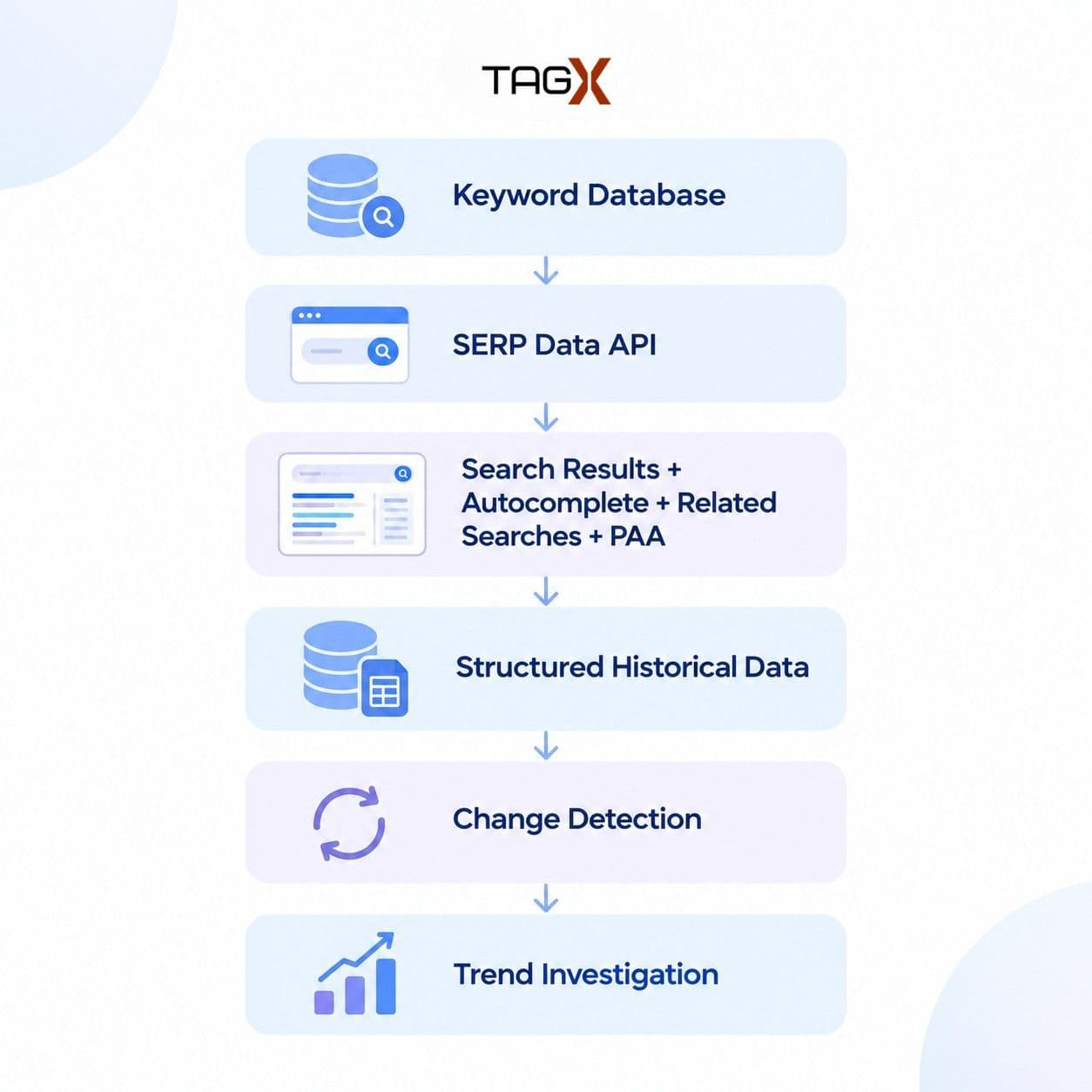
The SERP API collects the relevant search signals. Those results are stored in a structured format, allowing new collections to be compared against previous snapshots.
From there, businesses can identify changes such as new query variations, recurring questions, new domains, ranking movement, or changes in SERP features.
The workflow can look like this:
The process can then be connected to existing business datasets.
For example, an ecommerce company could compare search changes with product availability and pricing. An SEO team could compare emerging queries with content performance. A research team could combine search signals with broader market data.
This is where automation becomes more valuable than one-off searches: the system keeps collecting the same signals, making changes easier to identify over time.
Businesses evaluating different SERP collection approaches can refer to TagX's guide to the top SERP APIs for search data collection in 2026 for a broader look at SERP API capabilities.
For developers building their own data workflows, TagX's SERP API guide for developers covers considerations around programmatic SERP data collection.
The Bottom Line
Google Search contains many small signals that can reveal how search behavior is changing.
Autocomplete can surface new query variations. Related searches can expand a topic. People Also Ask can reveal recurring questions. SERP changes can show new competitors and content. Location-based collection can expose regional differences.
None of these signals needs to stand alone.
When a SERP Data API collects them repeatedly, businesses can build a historical view of how search results and search queries evolve.
That makes SERP data useful not just for checking rankings, but for discovering emerging topics, monitoring competitors, supporting Market Research, understanding customer questions, and spotting changes worth investigating.
Looking to collect and monitor Google Search signals at scale? Explore how TagX can help you build a structured SERP data workflow for your use case.