

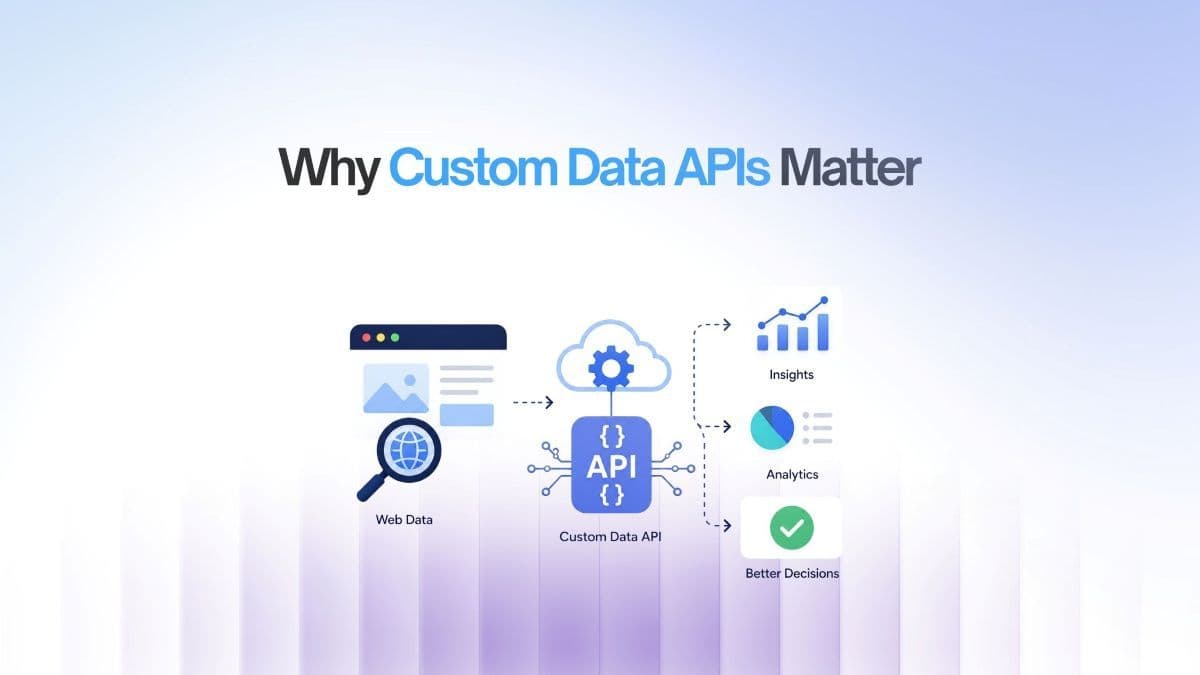
In today’s digital world, businesses generate and rely on massive amounts of online information. However, collecting and transforming this data into meaningful insights can be challenging.
Web Scraping helps organizations gather valuable web data, but converting that information into actionable business intelligence requires a more advanced approach.
A Custom Data API enables businesses to access, organize, and integrate data efficiently, helping teams make faster and smarter decisions.
What Is a Custom Data API?
A Custom Data API is a tailored solution that allows businesses to collect, process, and deliver specific data according to their unique requirements.
Unlike standard APIs that provide limited functionality, custom APIs are designed around a company’s goals, data sources, and workflows.
A Custom Data API works as a bridge between different platforms, websites, databases, and applications.
It allows businesses to access structured information without manually collecting data, making operations more efficient and scalable.
For example, companies can use a custom API to collect market trends, competitor information, pricing updates, customer insights, or industry-specific data and integrate it directly into their internal systems.
Why Do Businesses Need Custom Data APIs?
Businesses today need accurate and timely information to stay competitive. Manual data collection methods are often slow, inconsistent, and difficult to scale.
This is where custom data solutions provide significant value.
A Custom Data API helps businesses:
- Automate repetitive data collection tasks.
- Access accurate and structured information.
- Connect multiple data sources easily.
- Improve decision-making with updated insights.
- Reduce dependency on manual processes.
Whether a company needs market research, competitive analysis, or operational data, custom APIs provide a reliable way to access the information required for growth.
How Real-Time Data APIs Transform Business Operations
A real-time data API allows businesses to access updated information instantly whenever they need it. Instead of relying on outdated reports or delayed updates, organizations can make decisions based on current data.
Real-time data APIs are commonly used for:
- Monitoring market changes.
- Tracking competitor activities.
- Updating business dashboards.
- Improving customer experiences.
- Supporting automated workflows.
For example, eCommerce companies can use real-time data to monitor product prices, availability, and market trends, helping them respond quickly to customer demands.
Web Scraping API: Turning Online Data Into Valuable Insights
A web scraping api provides an automated way to extract information from websites and convert it into structured data. While traditional web scraping requires significant technical effort, an API-based approach makes data collection faster, more reliable, and easier to integrate.
Businesses can use web scraping APIs for:
- Market research.
- Lead generation.
- Competitor monitoring.
- Content analysis.
- Business intelligence.
By combining web scraping capabilities with custom API solutions, companies can transform large volumes of online information into useful business insights.
The Importance of API Data Integration
API data integration plays a crucial role in connecting different systems and ensuring smooth data flow across business operations. Instead of managing information across separate platforms, businesses can create connected ecosystems where data moves automatically.
Effective API data integration helps organizations:
- Improve workflow efficiency.
- Eliminate data silos.
- Enhance reporting accuracy.
- Create better customer experiences.
A well-designed Web API allows applications and platforms to communicate seamlessly, making business processes faster and more automated.
Benefits of Custom Data APIs
The benefits of custom data APIs go beyond simple data collection. They provide businesses with flexible solutions designed for their specific needs.
Key benefits include:
Better Data Accuracy
Custom APIs help deliver clean, structured, and relevant data.
Improved Business Decisions
Access to reliable information allows teams to make informed decisions.
Greater Scalability
Businesses can expand their data requirements without rebuilding their entire system.
Increased Automation
Custom APIs reduce manual work by automating data gathering and processing.
Competitive Advantage
Companies can respond faster to market changes with real-time insights.
Want to unlock the power of your web data? Connect with TagX today and explore our custom data API solutions.
Conclusion
Turning web data into meaningful business decisions requires more than collecting information, it requires a reliable way to access, process, and integrate data.
Custom Data APIs help organizations transform online data into actionable insights through automation, real-time access, and seamless integration.
At TagX, businesses can leverage advanced data solutions to collect, manage, and utilize valuable web information more effectively.
Whether you need scalable data extraction, custom API development, or smarter data workflows, the right solution can help your business make confident, data-driven decisions.