


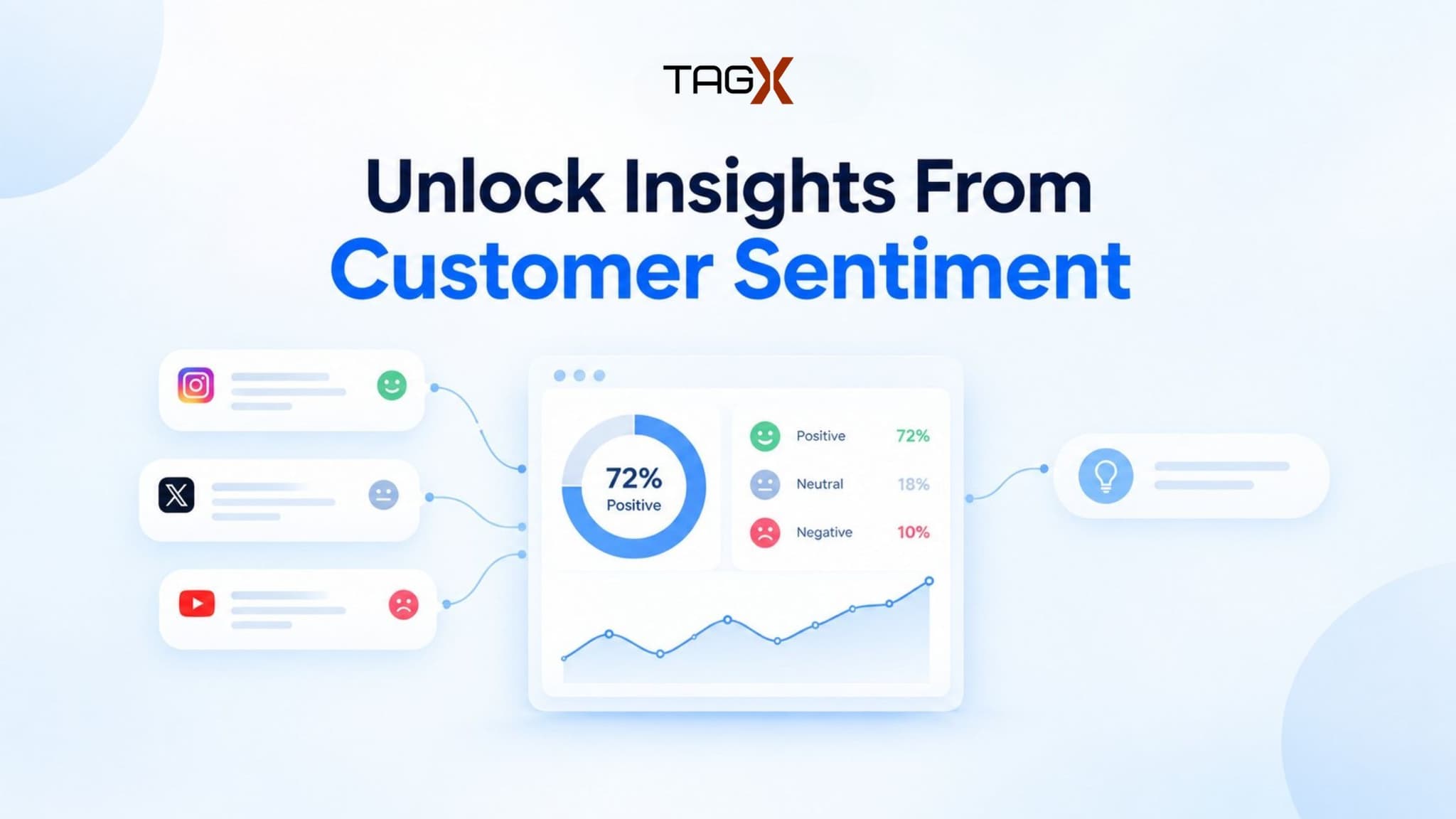
Customers leave behind opinions everywhere online. They review products, discuss brands on social media, share travel experiences, participate in forums, and comment on the products and services they use.
For businesses, this creates a valuable source of customer intelligence—but also a data problem. Thousands of reviews and conversations are difficult to read, categorize, and compare manually.
Sentiment analysis helps turn this unstructured feedback into usable insight.
By analyzing the language in reviews, posts, comments, and other online content, businesses can identify whether opinions are positive, negative, or neutral and uncover the topics driving those opinions.
Instead of simply knowing that a product has a 4.3-star rating, a business can understand why customers like it, what they dislike, and how those opinions are changing over time.
What Is Sentiment Analysis?
Sentiment analysis is the process of analyzing text to determine the opinion or emotional tone expressed in it.
At its simplest, sentiment analysis classifies content into three categories:
- Positive: praise, satisfaction, recommendations, or favorable opinions
- Negative: complaints, frustration, dissatisfaction, or criticism
- Neutral: factual statements or content without a clearly positive or negative opinion
However, useful sentiment analysis can go beyond these three categories.
It can identify the specific topics, products, features, or experiences that customers are talking about and determine the sentiment associated with each one.
For example:
“The phone takes amazing photos, but the battery barely lasts a day.”
A simple classification might label the review as positive or negative. A more detailed analysis can identify:
- Camera quality → Positive
- Battery life → Negative
- Overall review → Mixed
This additional context makes sentiment data much more useful for product teams, researchers, analysts, and decision-makers.
For a broader look at why sentiment analysis matters and where it can be applied, see this guide on sentiment analysis and its applications.
Where Does Sentiment Data Come From?
Sentiment analysis depends on having enough relevant text to analyze. Businesses can collect opinions from many publicly available online sources.
Product Reviews
Product reviews provide direct feedback about what customers think of products after using them.
Businesses can analyze sentiment around:
- Product quality
- Features
- Pricing
- Packaging
- Delivery
- Durability
- Customer service
Social Media
Social platforms contain real-time conversations about brands, products, companies, and trends.
Social sentiment data can help businesses monitor brand perception, identify emerging conversations, and understand how people are reacting to specific events or products.
Forums and Online Communities
Forums often contain detailed discussions that go beyond traditional ratings.
Users may explain why they prefer one product over another, discuss problems they have encountered, or share experiences with a company.
This makes forums useful for understanding the reasoning behind customer opinions.
Travel and Review Platforms
Travelers regularly share opinions about hotels, airlines, restaurants, destinations, and experiences.
Analyzing these reviews can reveal recurring themes around service quality, cleanliness, location, amenities, delays, and other aspects of the travel experience.
App Stores
App reviews can provide insight into usability, performance, features, crashes, subscriptions, customer support, and other aspects of the user experience.
Other Online Sources
Depending on the use case, businesses can also analyze relevant content from blogs, news websites, marketplaces, discussion boards, and other public web sources.
The more relevant sources a business can consistently monitor, the more complete its view of customer sentiment can become.
What Data Can Businesses Collect for Sentiment Analysis?
The text itself is important, but sentiment analysis becomes much more useful when it is combined with the context surrounding that text.
A structured sentiment dataset can include fields such as:
| Data Type | Example |
|---|---|
| Review or comment | “Delivery was extremely fast” |
| Sentiment | Positive |
| Rating | 5/5 |
| Topic | Delivery |
| Product | Product A |
| Brand | Brand X |
| Platform | Review site |
| Author | Reviewer |
| Timestamp | Publication date |
| Location | Country or region, where available |
| Engagement | Likes, replies, shares |
| Competitor mention | Brand Y |
| Source URL | Original content URL |
This allows businesses to analyze sentiment by product, brand, topic, location, platform, competitor, or time period instead of treating every opinion as an isolated piece of text.
How Different Industries Can Get Better Insights From Sentiment Data
The value of sentiment data changes depending on the industry and the questions a business needs to answer.
| Industry | Sentiment Insights | Business Use |
|---|---|---|
| Travel | Reviews, service, amenities, destinations | Improve guest experience & benchmark competitors |
| Ecommerce | Products, features, delivery, pricing | Improve products & understand customer preferences |
| Real Estate | Properties, locations, developers, amenities | Track reputation & buyer sentiment |
| Finance | Stocks, companies, investors, market trends | Monitor market perception & emerging narratives |
| Automotive | Models, features, reliability, ownership | Compare models & identify customer concerns |
You can explore how structured data supports different business requirements across Travel, Ecommerce, Real Estate, Finance, and Automotive.
From Online Content to Usable Sentiment Data
Sentiment analysis does not begin with the sentiment model. It begins with the data.
Customer opinions are usually scattered across different websites and platforms, often in different formats. Before sentiment can be analyzed consistently, this information needs to be collected, structured, and prepared for downstream processing.
A typical workflow can look like:
Online Sources → Data Collection → Structured Data → Sentiment Analysis → Business Insights
Web scraping helps collect relevant customer opinions, reviews, and conversations from publicly available web sources for sentiment analysis.
Instead of manually collecting reviews or building a separate extraction process for every source, businesses can use automated data pipelines to collect relevant information and bring it into their own databases, analytics systems, NLP workflows, or AI applications.
The structured output might contain fields such as:
product
brand
review_text
rating
platform
timestamp
author
url
A sentiment-analysis system can then process the review_text and add additional information such as:
sentiment
sentiment_score
topic
aspect
emotion
This creates a richer record that can be analyzed alongside product, pricing, market, or competitor data.
Why Data Quality Matters in Sentiment Analysis
A sentiment model can only work with the information it receives.
If the underlying data is incomplete, outdated, poorly structured, or missing important sources, the resulting sentiment picture may not accurately represent the market.
A useful sentiment data pipeline therefore needs to consider:
- Source coverage: Are the relevant platforms and websites represented?
- Freshness: How recently was the information collected?
- Consistency: Are fields structured in a standardized format?
- Context: Is the review connected to the right product, brand, or topic?
- Historical data: Can sentiment be compared over time?
- Source attribution: Can analysts trace the opinion back to its original source?
These factors matter because sentiment analysis is not simply about assigning a label to a sentence. It is about building a reliable picture of what customers think and why.
Conclusion
Customers are already generating enormous amounts of feedback across reviews, social platforms, forums, marketplaces, and other online channels.
The challenge is turning that scattered information into something businesses can consistently understand and act upon.
Sentiment analysis provides a way to interpret these opinions at scale, helping businesses monitor brand perception, improve products, understand customer experience, analyze competitors, and identify changing market expectations.
The value becomes even greater when sentiment is connected with structured information such as products, brands, topics, ratings, locations, competitors, and timestamps. This gives businesses a more complete view of not only what customers are saying, but what is driving those opinions.
With the right data collection and structuring workflow, businesses can build sentiment-analysis pipelines around the sources and information most relevant to their industry. Looking to collect customer opinions at scale for sentiment analysis? See what TagX can build for your data workflow.