


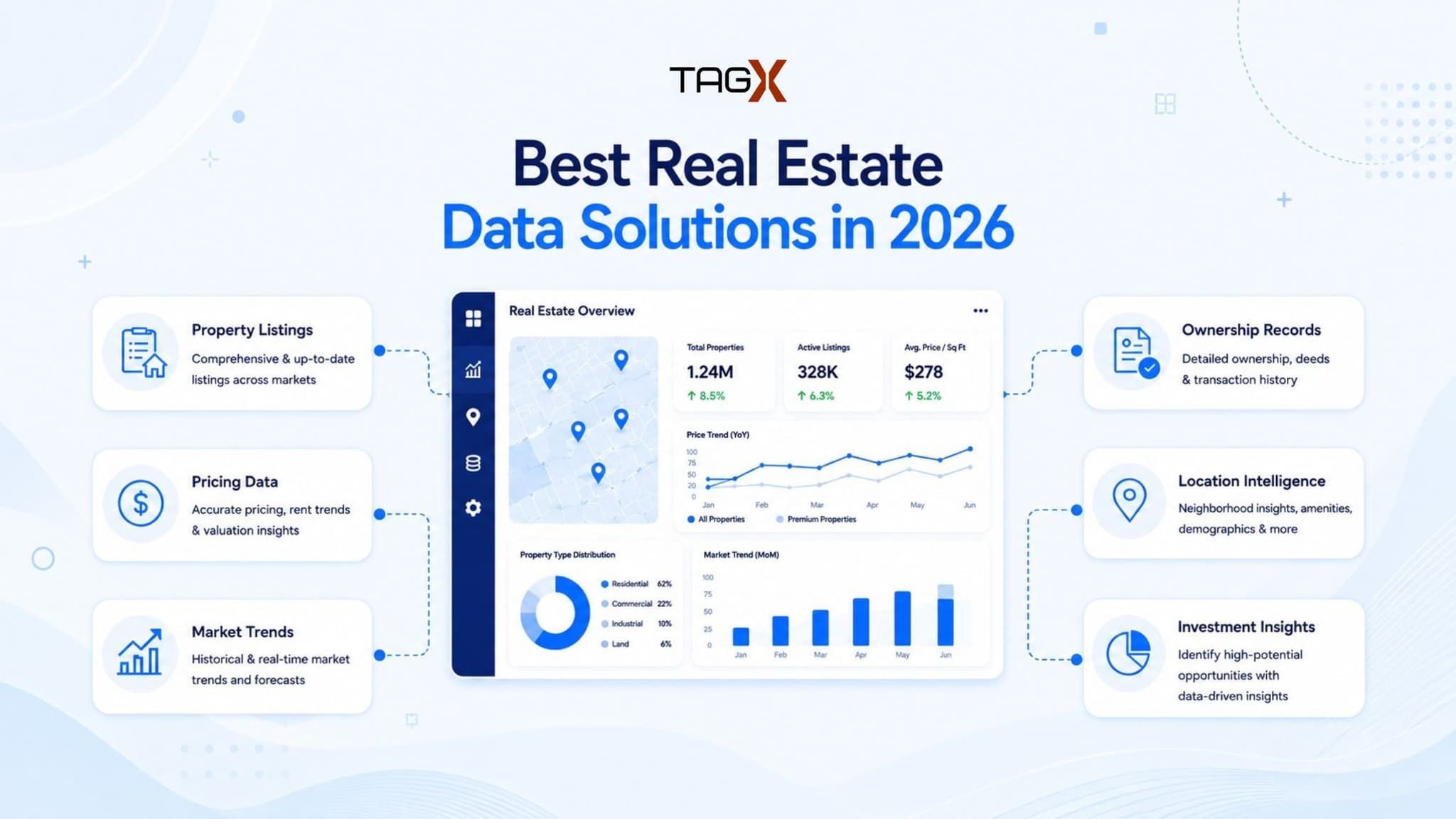
Real estate businesses increasingly rely on structured property data to understand markets, monitor listings, evaluate investments, and identify changes in pricing and demand. However, collecting property information across multiple websites, markets, and data sources can become difficult to manage as requirements grow.
This is where real estate data solutions can help. Depending on the provider, businesses can access property listings, pricing, rental information, property attributes, market data, ownership information, parcel data, and location intelligence through APIs, datasets, bulk files, or managed data pipelines.
But not every provider offers the same type of coverage or delivery model. Some focus on standardized property records, while others specialize in web-based listing data, parcel information, or customized data collection.
This guide compares some of the leading real estate data solutions in 2026 based on their data types, coverage, freshness, delivery options, scalability, customization, pricing, and common use cases.
What Should You Look for in a Real Estate Data Solution?
The right provider depends on the type of property information your business needs and how that information will be used.
Before choosing a solution, consider:
- Data types: Property listings, prices, rentals, transactions, ownership, valuations, property attributes, market and location data.
- Geographic coverage: Countries, states, cities, property portals, or specific markets supported.
- Data freshness: How frequently listings, prices, availability, and other records are updated.
- Delivery methods: APIs, CSV, JSON, XML, bulk files, cloud storage, or direct database delivery.
- Customization: Whether you can specify sources, fields, geography, and refresh schedules.
- Scalability: Whether the provider can handle increasing data volumes and additional sources.
- Pricing: Transparent self-service pricing, usage-based pricing, or customized enterprise contracts.
- Data quality: Accuracy, consistency, normalization, and duplicate handling across sources.
Top Real Estate Data Solutions in 2026
The following table provides a quick comparison of leading providers before looking at their individual capabilities.
| Provider | Key DataTypes | Geographic Coverage | Data Delivery | Custom Collection | Scalability | Pricing |
|---|---|---|---|---|---|---|
| TagX | Property listings, pricing, rentals, property attributes, market & location data | Global, source-dependent | API, CSV, JSON, XML, cloud | High | High | Custom quote |
| ATTOM | Property, ownership, sales, mortgage, valuation, foreclosure & neighborhood data | U.S. | API, bulk, cloud | Medium | High | Trial + custom/usage-based |
| Cotality | Property, ownership, valuation, risk, imagery & market data | Primarily U.S. | API, bulk & enterprise delivery | High | High | Custom |
| Custom | Parcel, ownership, boundaries, land use & location data | U.S. + selected markets | API, bulk files, mapping tiles | Medium | High | Self-serve + enterprise |
| Bright Data | Property listings, prices, property attributes & web data | Global, source-dependent | Datasets, APIs & cloud | High | High | Usage-based |
| Apify | Property listings and customizable web data | Global, source-dependent | API, JSON, CSV & other formats | High | High | Usage-based |
Coverage, update frequency, available fields, and pricing can vary by product, source, geography, volume, and commercial agreement.
1. TagX — Best for Custom, Large-Scale Real Estate Data Collection
TagX provides managed data collection for businesses that need property information from multiple online sources. Rather than working only with a predefined property database, businesses can specify the sources, fields, geography, and frequency that match their requirements.
Its real estate data capabilities can cover property listings, pricing, rental information, property attributes, market information, and location-related data. Data can be structured and delivered through APIs, CSV, JSON, XML, cloud storage, or other agreed formats.
Key capabilities:
- Property listing and pricing data
- Rental and property attribute information
- Custom source and field selection
- Geographic-specific data collection
- Scheduled or ongoing updates
- API and file-based delivery
- Large-scale data collection
- Structured and normalized outputs
Best for: Property marketplaces, PropTech companies, investors, market research, competitive monitoring, and businesses requiring customized real estate data collection.
If you are comparing different approaches to property listing collection, our guide to the best real estate web scraping services for property listings provides additional information on the available options.
For businesses with specific requirements, speaking with the TagX team can also help clarify available sources, fields, delivery formats, and collection frequency.
2. ATTOM — Best for U.S. Property Intelligence
ATTOM is a major provider of U.S. property data, covering more than 160 million properties. Its platform includes property characteristics, ownership, sales history, mortgages, valuations, foreclosures, neighborhood information, and other property-related data.
Key capabilities:
- Extensive U.S. property coverage
- Property characteristics
- Ownership and transaction information
- Mortgage and foreclosure data
- Valuation information
- Neighborhood and location data
- REST APIs and bulk data delivery
Best for: Property intelligence, investment analysis, valuation, lending, insurance, and real estate applications.
ATTOM also provides API access and trial options, while larger or specialized requirements can be handled through customized commercial arrangements.
3. Cotality — Best for Enterprise Property and Risk Intelligence
Cotality, formerly known as CoreLogic, focuses on property intelligence and data solutions for enterprise users. Its offerings cover areas such as property characteristics, ownership, valuation, risk, location, imagery, and market information.
Key capabilities:
- Property and ownership information
- Valuation and market intelligence
- Risk and climate-related data
- Property imagery
- Location intelligence
- Enterprise API and bulk delivery
Best for: Lenders, insurers, institutional investors, valuation teams, and organizations with complex property intelligence requirements.
Pricing: Primarily customized based on requirements.
4. Regrid — Best for Parcel and Location Data
Regrid specializes in parcel-level property and geospatial information. Its data is particularly useful when property boundaries, land use, ownership, and geographic relationships are more important than online listing information.
Key capabilities:
- Parcel boundaries
- Property and ownership information
- Land-use data
- Geospatial information
- API access
- Bulk data
- Mapping tiles
Best for: GIS applications, land analysis, mapping platforms, location intelligence, zoning research, and property analysis.
Pricing: Self-service and enterprise options are available depending on coverage and usage.
5. Bright Data — Best for Large-Scale Web Data Collection
Bright Data provides web data collection infrastructure that businesses can use to gather information from online sources. Its real estate applications can include property listings, prices, property characteristics, and other publicly available information.
Key capabilities:
- Large-scale web data collection
- Global source coverage
- Real estate datasets
- API-based collection
- Cloud delivery
- Flexible extraction workflows
Best for: Market research, competitive monitoring, property listing collection, and technical teams managing large-scale web data projects.
Pricing: Generally usage-based and dependent on the selected product, volume, and collection requirements.
6. Apify — Best for Flexible Developer-Led Collection
Apify is a developer-oriented platform for creating and running web data collection workflows. Its ecosystem includes ready-made and configurable actors that can collect information from different websites.
Key capabilities:
- Customizable extraction workflows
- Ready-made web scrapers
- API access
- JSON and CSV outputs
- Scheduled workflows
- Developer-oriented infrastructure
Best for: Technical teams, developers, prototypes, and businesses that prefer greater control over their own data collection workflows.
Pricing: Usage-based, depending on platform resources and workload.
Real Estate Data Solutions: Which One Is Right for Your Business?
The most suitable provider depends largely on the type of real estate data you need and how you plan to use it.
For custom property listing collection: A managed solution such as TagX can be useful when you need specific websites, fields, locations, and update schedules.
For standardized U.S. property records: ATTOM can be considered when ownership, transactions, valuations, mortgages, and property characteristics are important.
For enterprise property intelligence: Cotality may be suitable for organizations working across lending, insurance, valuation, investment, and risk.
For parcel and GIS information: Regrid is worth considering when property boundaries and geospatial information are central to the project.
For large-scale web collection: Bright Data can be considered by organizations looking for web data infrastructure and scalable collection capabilities.
For developer-controlled workflows: Apify can be useful when a technical team wants to configure and manage its own extraction processes.
Businesses evaluating real estate scraping providers can also review companies that specialize in web scraping for real estate listings to better understand how managed services and developer-led solutions compare.
What Does Real Estate Data Cost?
Pricing varies significantly between providers because real estate data requirements are rarely identical.
Some platforms use usage-based API pricing, while others provide subscription plans, bulk-data licenses, or customized enterprise contracts.
The final cost can depend on:
- Number of properties or records
- Geographic coverage
- Number of sources
- Number of fields collected
- Update frequency
- API request volume
- Historical data requirements
- Data delivery format
- Custom processing or normalization
For web-based data collection, customized requirements can also affect pricing because adding sources, fields, locations, or higher refresh frequencies may require additional infrastructure.
For this reason, comparing only the advertised starting price may not provide a complete picture. It is usually more useful to compare the total data coverage, freshness, customization, delivery method, and volume included in the price.
Final Thoughts
Choosing a real estate data solution is ultimately about finding the right balance between coverage, freshness, customization, scalability, and cost.
Standardized property-data providers can be useful when you need established records such as ownership, transactions, valuations, parcels, or property characteristics. Web data platforms can be more appropriate when your requirements involve collecting current information from online property sources.
For businesses with specific data requirements, factors such as source selection, required fields, geographic coverage, refresh frequency, and delivery format can be just as important as the provider itself.
If you are exploring a customized real estate data requirement and would like to understand which collection and delivery approach may fit your use case, you can speak with our team for a better understanding of the available options.
You can also explore our comparison of top real estate data scraping tools for property investors for another perspective on evaluating real estate data collection solutions.