


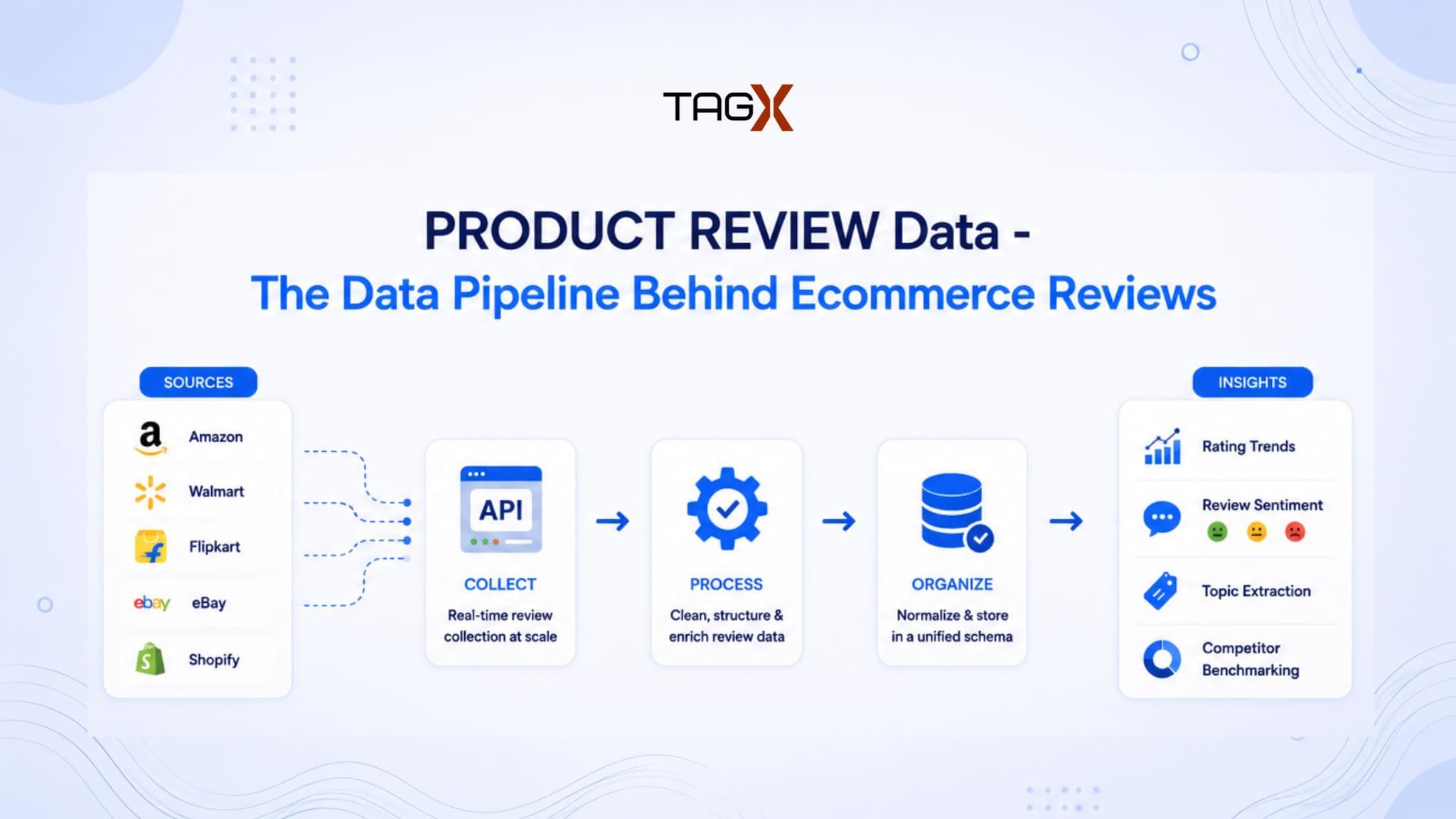
A single product can carry reviews on Amazon, Walmart, eBay, Google, and half a dozen niche marketplaces — each with its own layout, rating scale, and way of hiding data from casual view. Individually, none of these reviews are hard to read. Collectively, at the scale most ecommerce businesses now operate at, they become one of the most valuable — and most difficult to use — data sources a company has.
Product review scraping is the practice of collecting these reviews programmatically, across products and marketplaces, and converting them into structured, standardized datasets that can actually be analyzed. Done well, it turns scattered customer opinions into a dataset that supports pricing decisions, product roadmaps, and competitive strategy. Done poorly, it produces spreadsheets full of gaps, duplicates, and mismatched fields nobody trusts enough to act on.
This guide covers what a review scraping pipeline needs to collect, the technical obstacles that get in the way, how businesses normalize review data into one usable structure, and what that structured data is actually used for.
Why Businesses Scrape Product Reviews at Scale
A handful of reviews, read manually, tell you what a few customers thought. Thousands of reviews, collected consistently across products and competitors, tell you something closer to the truth about a market.
Businesses scrape reviews at scale for a few recurring reasons:
- Coverage — Manually checking a handful of listings doesn't reflect a catalog with hundreds or thousands of SKUs, each carrying its own review history.
- Comparability — A single retailer's own reviews mean less without a view of how competing products are rated on the same criteria.
- Timeliness — Ratings and complaint volume shift quickly after a promotion, a stockout, or a quality issue; periodic manual checks miss the window to react.
- Depth — Review text and images surface complaints, feature requests, and usage patterns that structured survey data rarely captures.
The catch is that reviews don't arrive in a form that's ready for any of this. Every platform displays reviews the same way on screen — a name, a star rating, some text — but that visual consistency hides genuinely different data models underneath. Turning that into usable intelligence requires two separate things done well: collecting the data completely, and structuring it consistently. This article deals with both.
Why Businesses Scrape Product Reviews at Scale
A handful of reviews, read manually, tell you what a few customers thought. Thousands of reviews, collected consistently across products and competitors, tell you something closer to the truth about a market.
Businesses scrape reviews at scale for a few recurring reasons:
- Coverage — Manually checking a handful of listings doesn't reflect a catalog with hundreds or thousands of SKUs, each carrying its own review history.
- Comparability — A single retailer's own reviews mean less without a view of how competing products are rated on the same criteria.
- Timeliness — Ratings and complaint volume shift quickly after a promotion, a stockout, or a quality issue; periodic manual checks miss the window to react.
- Depth — Review text and images surface complaints, feature requests, and usage patterns that structured survey data rarely captures.
The catch: reviews don't arrive ready for any of this. Turning them into usable data means collecting completely and structuring consistently — both covered below.
Where Product Review Data Comes From
Product reviews aren't confined to one marketplace, and a scraping strategy built around a single source usually undersells what's available. Common sources include:
- Marketplaces — Amazon, eBay, Walmart, and similar platforms, where reviews are tied directly to a product listing or ASIN.
- Location-based review platforms — Google Business Profiles and similar sources, which matter for retailers with physical stores rather than a single online listing.
- Category and reputation sites — Yelp and comparable platforms, where reviews are often about a business or location rather than a specific SKU.
- Brand and DTC sites — first-party review widgets on a retailer's own product pages.
Each source structures its data differently: Amazon ties reviews to an ASIN and variant, eBay skips star ratings for feedback percentages, and Yelp's average excludes a filtered tier. Merging these into one number without preserving the native scale misrepresents every platform involved. More on this in how businesses leverage online review data from Amazon, eBay, Yelp, and other platforms.
Multi-location retailers face a different structure entirely — reviews organized around a store, not a product.
What to Collect: The Fields Behind a Usable Review Dataset
Before writing a single line of scraping logic, it helps to define the schema the pipeline is working toward. At a high level, a usable review record spans six categories:
review content (text, title, rating, date), product context (ID, variant, category), reviewer signal (name where public, verification status, badges), rating detail, engagement (helpful votes, replies), and metadata (source platform, region, timestamp, images).
Not every project needs every field — pricing monitoring may only need ratings and dates, while product research needs full text and images. Decide the schema upfront. Full field breakdown: how to scrape Amazon reviews at scale.
The Core Challenges in Scraping Reviews at Scale
Reading a handful of reviews off a single page is trivial. Collecting them reliably across thousands of listings, several marketplaces, and recurring schedules is a different problem — one that tends to fail quietly rather than loudly, so the dataset can look complete without actually being complete. At a high level, the recurring obstacles fall into six buckets:
| Challenge | Why it matters |
|---|---|
| Pagination | Review volumes vary by product, and some platforms cap how many pages are reachable at all — undercounting silently rather than erroring out. |
| Dynamic pages | Reviews often load via JavaScript or infinite scroll, so a scraper reading only static HTML can miss most of what's on the page. |
| Anti-bot systems | Rate limits, fingerprinting, and CAPTCHAs can block collection outright, or worse, quietly serve a stripped-down page that looks like a valid response. |
| Inconsistent schemas | Every source names, formats, and structures its fields differently, which breaks naive field-by-field extraction. |
| Product variants | Reviews aren't always cleanly attributed to the specific size, color, or configuration a customer bought. |
| Duplicate records | Repeated crawls, retries, and overlapping pagination can enter the same review more than once, inflating counts and skewing ratings. |
Each looks like a minor bug alone. At scale, they're the difference between a dataset that looks complete and one that is. Full mechanics: the engineering challenges of reliable review scraping at scale.
Normalizing and Unifying Review Data Across Sources
Collection is only half the job. A dataset pulled from five marketplaces in five different formats isn't analysis-ready until it's been normalized into one consistent structure. This step typically involves:
- Standardizing ratings — converting every source's rating into a common numeric scale, while preserving the original representation where source fidelity matters.
- Normalizing dates — converting varied date formats into one consistent standard (e.g., ISO 8601) so records can be compared and sorted across sources.
- Assigning stable identifiers — using a platform-native review ID where available, and a generated fingerprint (reviewer + date + rating + content) where it isn't, so the same review is never double-counted.
- Mapping variant and location context — attaching the correct product variant or store location to every review, rather than collapsing everything under one parent listing.
- Handling missing fields gracefully — storing unavailable fields as null instead of discarding an otherwise usable review.
- Preserving platform-native fields — an eBay Detailed Seller Rating or a Yelp filtered-review flag carries meaning that shouldn't be flattened away just to fit a common structure.
This is where reviews stop being "Amazon data" or "Google data" and become one queryable dataset. Most ad hoc efforts skip this step — which is why analysis often stalls at the spreadsheet. For retailers unifying reviews across dozens or hundreds of store locations, this normalization step is the whole game — see Google review collection for multi-location retail.
What Structured Review Data Is Used For
Once review data is collected and normalized, it feeds several distinct business functions — often from the same underlying dataset.
Competitive intelligence. Tracking a competitor's rating trend, review velocity, and recurring complaints can surface a quality issue, a pricing problem, or an upcoming promotion before it shows up in market share numbers.
Product research. Review text and images frequently surface feature requests and usage patterns that customers never mention in a formal survey — sizing complaints, durability issues, or use cases the original product listing didn't anticipate.
Customer feedback analysis. At scale, individual reviews stop being anecdotes and start being a signal. Recurring terms across hundreds of reviews — "runs small," "battery drains fast," "packaging damaged" — point to specific, fixable issues rather than isolated complaints.
Product development. Structured review data, filtered by variant, gives product teams a way to see which configuration of a product is underperforming, rather than treating an entire SKU family as a single average rating.
Pricing and market intelligence. Rating trends, review volume, and sentiment shifts — read alongside competitor pricing — help explain whether a rating change is linked to a price move, a stockout, or a genuine quality shift.
All five draw on the same foundation. Its quality — not the analysis on top — determines whether the insight can be trusted.
Building This In-House vs. Getting Structured Data Delivered
Everything described above is buildable in-house, and plenty of ecommerce and market research teams do build it, particularly once review data becomes central to a recurring decision. The tradeoff is that a scraping pipeline is never really "finished" — pages change, anti-bot systems tighten, and every new source adds another schema to maintain.
TagX helps businesses skip that maintenance cycle by delivering structured product review data — collected, deduplicated, and normalized across marketplaces — on a recurring schedule. Whether the requirement is a single marketplace or reviews unified across Amazon, eBay, Google, and other sources, the output lands as clean, structured records ready for analysis rather than another scraper to babysit.
If review data is core to how your team tracks products, competitors, or customer sentiment, talk to TagX about a sample dataset before committing engineering time to building the collection layer yourself.