

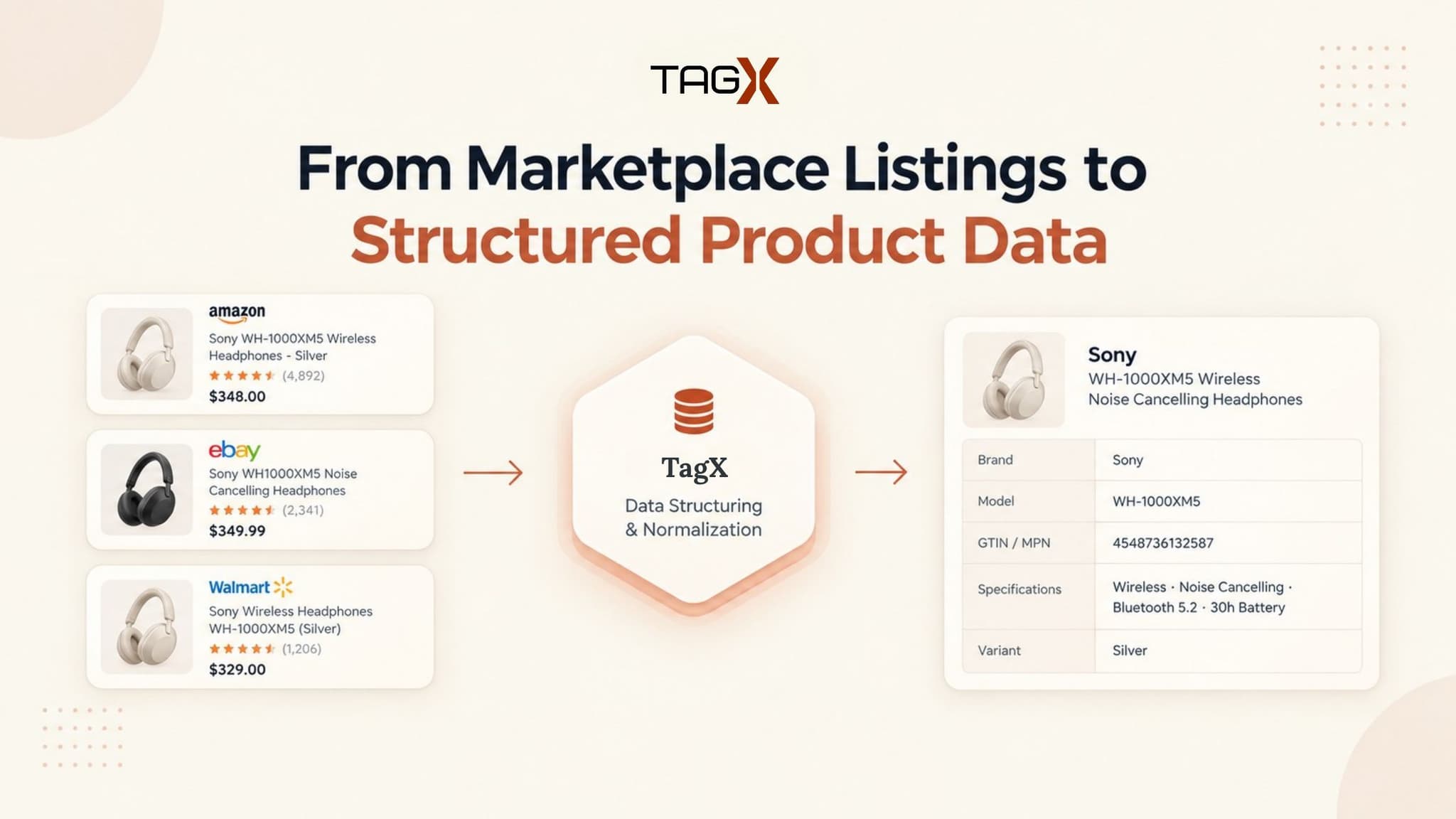
The same product can appear under different categories, names, attributes, and product structures depending on the marketplace.
A product listed under “Running Shoes” on one platform may appear under “Athletic Footwear” on another. Even when the category is similar, the surrounding product data can vary just as much. Titles, specifications, variants, brand names, identifiers, and attributes are often presented in different formats.
For businesses working with ecommerce data from multiple marketplaces, this creates a fundamental challenge: how do you bring inconsistent product data into one consistent structure?
This is where product taxonomy mapping becomes important.
By collecting, structuring, normalizing, and matching marketplace product data, businesses can create a common product structure that works across different ecommerce sources.
Why Product Taxonomy Differs Across Marketplaces
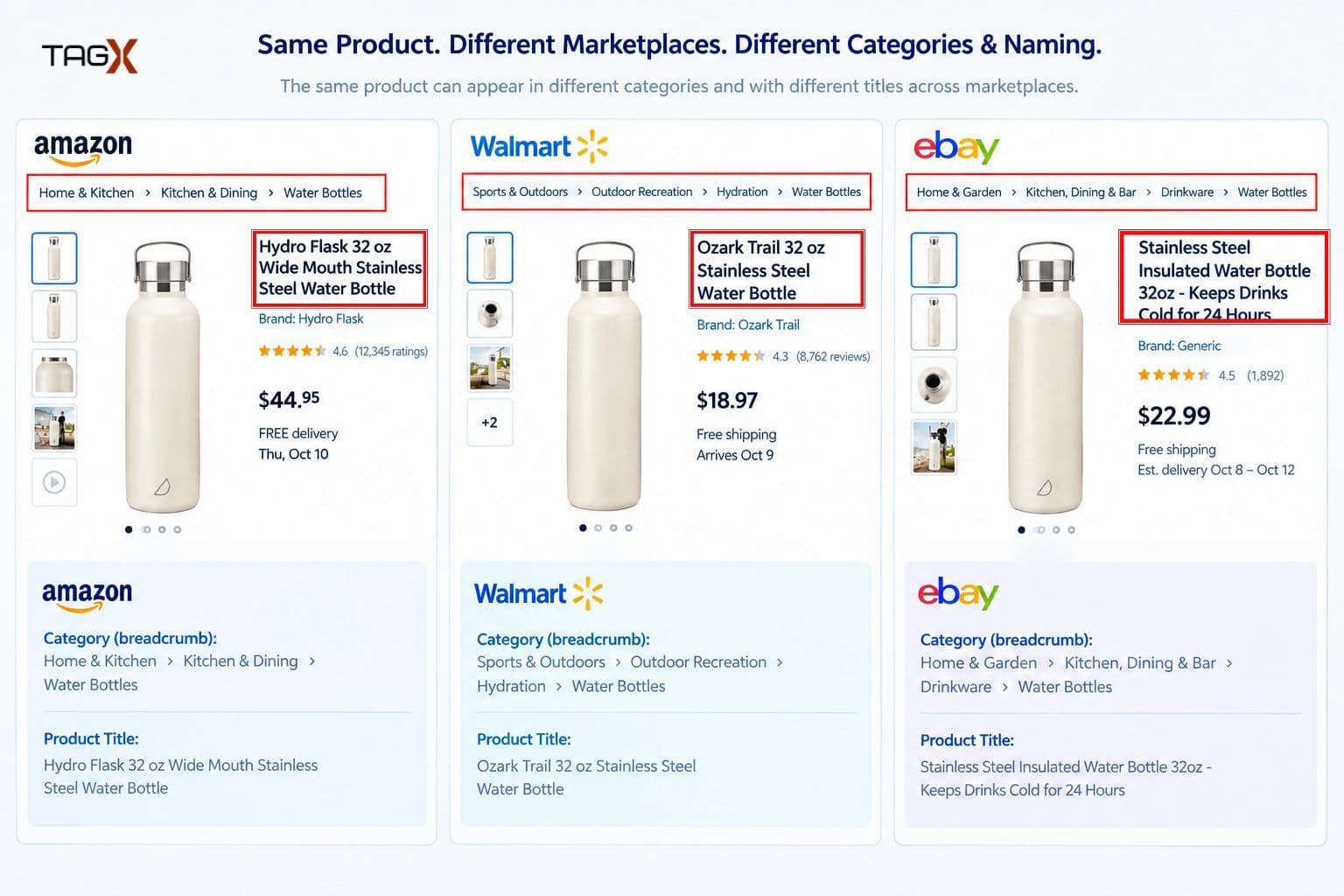
Every marketplace organizes its catalog according to its own product hierarchy.
One platform may use:
Electronics → Computers → Laptops
Another may structure a similar product as:
Electronics → Computers → Notebook Computers
The differences do not stop at category names. Marketplaces can also organize products differently based on attributes such as brand, size, color, storage, material, compatibility, or product type.
For a business collecting data from several sources, these differences make direct comparison difficult.
A product catalog may therefore contain:
- Different category names for similar products
- Marketplace-specific category hierarchies
- Different attribute names and values
- Different product identifiers
- Inconsistent title formats
- Different variant structures
- Missing or differently formatted specifications
The challenge is not simply collecting these fields. The data needs to be understood and standardized before products from different marketplaces can be compared reliably.
Taxonomy Mapping Starts With the Right Ecommerce Data
Product taxonomy mapping depends on the quality and completeness of the underlying product data.
Before a product can be mapped into a standardized taxonomy, businesses need access to the product information available on each marketplace.
Depending on the use case, this can include:
- Product title
- Brand
- SKU or marketplace product ID
- GTIN, UPC, EAN, or MPN
- Category and breadcrumb
- Product specifications
- Product attributes
- Variant information
- Price
- Availability
- Seller information
- Ratings and reviews
- Product URL
- Images
This is where ecommerce data collection becomes the foundation of taxonomy work.
Data can be collected from marketplace pages, feeds, or APIs and then transformed into a structured format that downstream systems can work with. Web scraping can also help collect product information from marketplaces where structured access is not available.
The objective is not just to gather pages. It is to turn marketplace product information into consistent, usable ecommerce data.
From Marketplace Categories to a Common Product Structure
Once product data has been collected, marketplace-specific categories can be mapped to a common taxonomy.
For example:
| Marketplace | Original Category | Standardized Category |
|---|---|---|
| Marketplace A | Computers → Notebook PCs | Laptops |
| Marketplace B | Electronics → Laptops | Laptops |
| Marketplace C | Computing → Portable Computers | Laptops |
The original marketplace category should generally be retained rather than overwritten. Keeping both values allows businesses to preserve source information while creating a standardized category for comparison.
A common structure can then be applied across products collected from multiple sources.
This becomes particularly useful when a business needs to combine marketplace catalogs, compare assortments, identify duplicate products, or build a unified product database.
Normalize Product Attributes, Not Just Categories
Taxonomy mapping is only one part of product normalization.
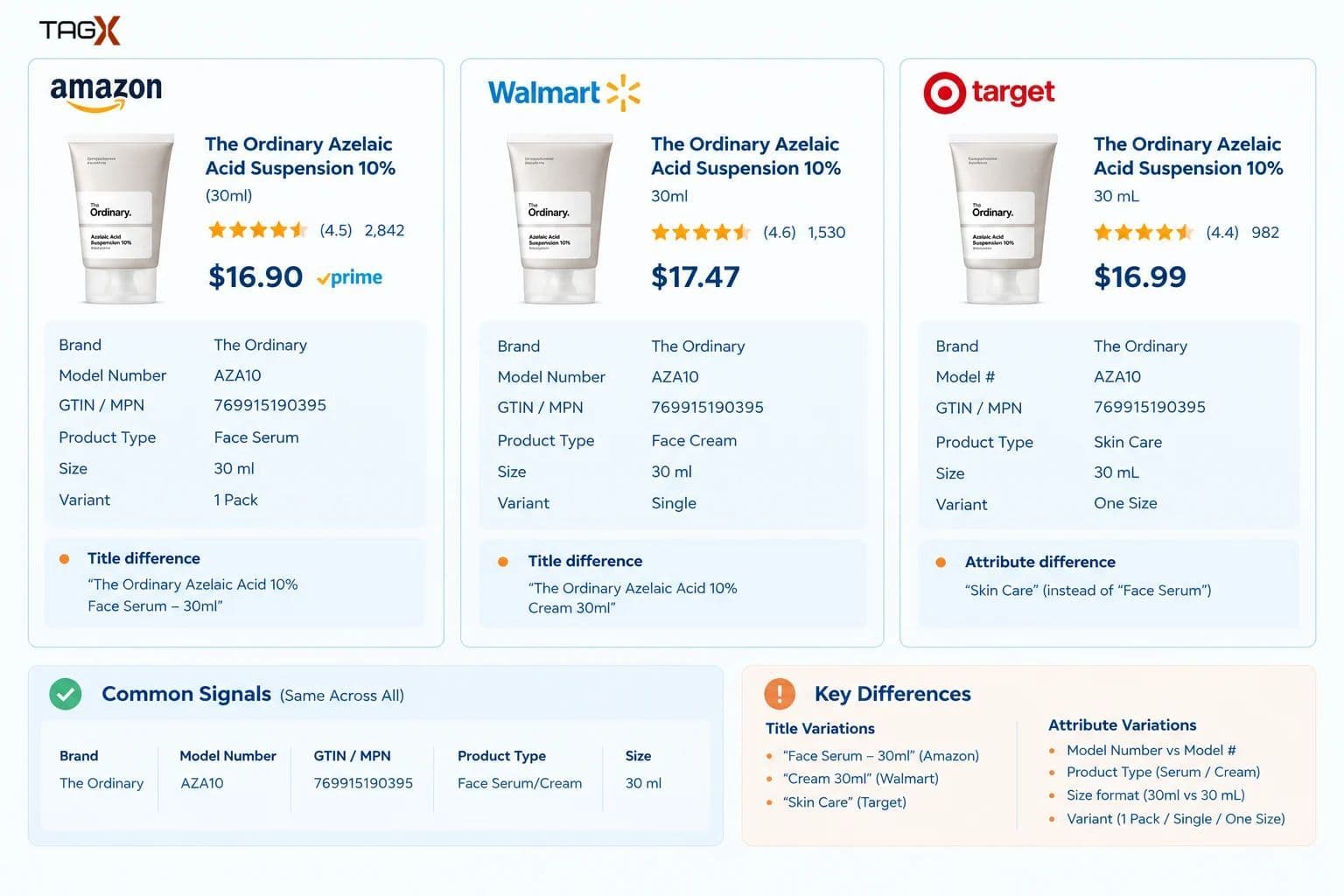
Two marketplaces may place a product in the same broad category but describe its attributes differently.
For example, one marketplace might list:
- Color: Midnight Black
- Storage: 1000 GB
- Pack Size: 2
Another could use:
- Colour: Black
- Capacity: 1 TB
- Quantity: 2 Pack
A standardized ecommerce dataset can normalize these values into a consistent structure:
- Color → Black
- Storage → 1 TB
- Quantity → 2
This makes the data easier to compare and process.
Attribute normalization can be particularly important for products with large numbers of specifications, such as electronics, appliances, beauty products, automotive parts, and consumer goods.
Product Matching and Taxonomy Mapping Work Together
A standardized taxonomy becomes much more useful when businesses can identify the same product across marketplaces.
Consider a laptop sold on three different platforms. Its listings may have different titles, category paths, URLs, and marketplace IDs. However, the underlying product may share identifiers such as a model number, GTIN, brand, or key specifications.
Product matching uses these signals to determine whether listings represent the same product or closely related variants.
Taxonomy mapping then helps place those matched products into a consistent category structure.
In practice, the two processes can work together:
Collect product data → Normalize attributes → Match products → Map taxonomy → Create standardized catalog
Businesses working across multiple ecommerce sources can combine product matching across marketplaces with a Data API with taxonomy normalization to build a more consistent product dataset.
How an Ecommerce Data API Supports Taxonomy Workflows
Maintaining a standardized product catalog becomes difficult when marketplace data needs to be collected repeatedly.
Products change. Prices change. Availability changes. Sellers change. New products and variants are added, while existing listings can be updated or removed.
An Ecommerce Data API can provide structured product data in a format that is easier for applications and internal systems to consume.
Instead of manually collecting and restructuring marketplace pages each time, businesses can work with structured fields such as product titles, categories, brands, identifiers, specifications, pricing, availability, and other product information.
This structured layer can then feed product catalog systems, matching workflows, pricing systems, research processes, or internal databases.
For businesses that need product feeds across multiple ecommerce sources, an Ecommerce Data API for tracking pricing, reviews, and product feeds at scale can provide the underlying data needed for these workflows.
Where Standardized Product Data Can Be Used
Once marketplace data has been normalized and mapped, the resulting dataset can support several ecommerce workflows.
- Catalog management: Businesses can create a more consistent view of products collected from different marketplaces.
- Product matching: Standardized identifiers and attributes can make it easier to compare listings and identify the same products across sources.
- Price monitoring: Comparable product data makes it easier to track how prices differ between marketplaces and how those prices change over time.
- Assortment tracking: Businesses can identify which products, brands, and categories are available across different ecommerce platforms.
- Competitor analysis: Structured product data can be used to compare competitor catalogs, product positioning, availability, and pricing.
For example, a retailer monitoring competitor prices needs more than the current price. It needs to know whether the products being compared are actually the same product, variant, or pack size. That is why product normalization and matching are important parts of a reliable price-monitoring workflow.
A structured approach to ecommerce price monitoring and tracking competitor prices can therefore build on the same underlying product data.
Handling Variants, Bundles, and Other Edge Cases
Not every product listing can be mapped with a simple category match.
Ecommerce catalogs contain many edge cases:
- Single products and multipacks
- Different sizes or colors
- Bundles containing multiple products
- Refurbished and new versions
- Regional product variants
- Seller-specific listings
- Products with incomplete specifications
A “Coffee Maker” and a “Coffee Maker 2-Pack” may belong to the same broad category but should not necessarily be treated as the same product.
Similarly, two listings for the same smartphone may differ by storage capacity, color, region, or bundle contents.
This is why taxonomy mapping should be performed alongside product attributes, identifiers, and variant information rather than relying only on category names.
A Repeatable Workflow for Cross-Marketplace Product Data
A reliable taxonomy process can be treated as a sequence of ecommerce data operations:
Collect → Structure → Normalize → Match → Map → Validate → Deliver
First, collect product information from the required marketplaces and sources.
Next, structure the raw information into consistent fields. Normalize category names, attribute labels, units, and values. Match products using identifiers and product-level signals. Map marketplace categories to a common taxonomy.
Finally, validate the resulting data and deliver it in a format that downstream systems can use, such as JSON, CSV, or through an API.
The process also needs to be repeatable. Marketplace data changes continuously, so a taxonomy that works today may require updates as categories, attributes, products, and listings evolve.
Build the Taxonomy on Consistent Ecommerce Data
Product taxonomy mapping is ultimately a data consistency problem.
Different marketplaces will continue to organize products differently. Their category structures, attributes, titles, identifiers, and listing formats will not always align.
The goal is therefore not to force every marketplace into the same structure at the source.
Instead, businesses can preserve the original marketplace data while creating a standardized product layer on top of it.
That layer makes it easier to match products, normalize attributes, compare catalogs, monitor prices, and work with ecommerce data across multiple sources.
For businesses managing large and frequently changing product catalogs, having structured ecommerce data is an important starting point.
Need structured ecommerce data across marketplaces? Talk to TagX about your Ecommerce Data API.