

Black Friday brings intense competition to ecommerce, with retailers competing for shoppers who can compare prices across multiple marketplaces in seconds. In 2025, U.S. consumers spent a record $11.8 billion online on Black Friday, a 9.1% increase from the previous year.
As retailers prepare for Black Friday 2026, competing with Amazon involves more than offering attractive discounts. Matching every price reduction can squeeze margins, while overlooking competitor price changes can leave products less competitive.
The challenge is knowing which price movements matter, which products deserve attention, and how competing offers have changed over time. Ecommerce data helps retailers examine product prices, promotional changes, stock availability, and historical pricing records before making pricing decisions.
Rather than reacting to every discount, retailers can use structured competitor data to understand the market and decide where a pricing response makes commercial sense.
Why Price Matching Alone Is Not Enough for Black Friday 2026
Amazon can change prices across products, sellers, and promotional periods. For retailers competing in the same categories, reacting to every discount can quickly turn into a race to the bottom.
Consider a pair of wireless headphones. Amazon drops its price, and another marketplace lists the same model for even less. Should a retailer match the lowest offer?
Not necessarily. Before changing the price, retailers need to consider:
- Product match: Are the listings for the exact same model, variant, and pack size?
- Availability: Is the competing product in stock and available to purchase?
- Offer differences: Do delivery costs, seller details, or promotional conditions affect the comparison?
- Profit margins: Would matching the price still make commercial sense?
These factors can change how competitive an offer actually is. The lowest listed price may not always be the most relevant benchmark, and a temporary discount may not justify an immediate price adjustment.
The goal isn't to match every price. It's to identify which price changes matter. By comparing equivalent products, tracking promotional activity, and reviewing price movements over time, retailers can make more informed decisions about where to compete and when to hold their position.
What Ecommerce Data Should Retailers Track Before Black Friday?
Preparing for Black Friday starts with identifying the data needed to compare products, prices, and competing offers consistently.
| Data type | What it helps retailers assess |
|---|---|
| Product identifiers and attributes | Whether listings represent equivalent products |
| Current and list prices | Differences in selling prices and advertised discounts |
| Historical prices and timestamps | How prices change over time |
| Stock availability | Whether competing products are available |
| Seller information | Differences between marketplace offers |
| Ratings and reviews | How competing products are positioned |
Product identifiers such as GTIN, EAN, UPC, and SKU can help match equivalent items when available. Additional attributes, including brand, model, size, and pack quantity, help prevent inaccurate comparisons between similar but different products.
Price information also needs context. An advertised discount does not necessarily establish how a product's current price compares with its previous selling price. Historical observations can help retailers investigate that difference.
Availability is another important factor. A lower-priced listing that is out of stock may present a different competitive situation from an available offer that shoppers can purchase immediately.
Retailers can use an Ecommerce Data API to collect structured product information from relevant ecommerce sources and integrate it into existing applications and data workflows. The available fields depend on the source and collection method.
The objective is to build a consistent dataset that allows products and offers to be compared on a like-for-like basis.
How to Monitor Amazon Prices Across Competing Retailers
Tracking Amazon prices becomes more useful when it is part of a repeatable monitoring process that covers the products and sources relevant to the business.
- Select the products and sources. Start with priority SKUs, brands, and categories where pricing competition is strongest. Identify the marketplaces and retailer websites that matter to the target market rather than attempting to monitor every available source.
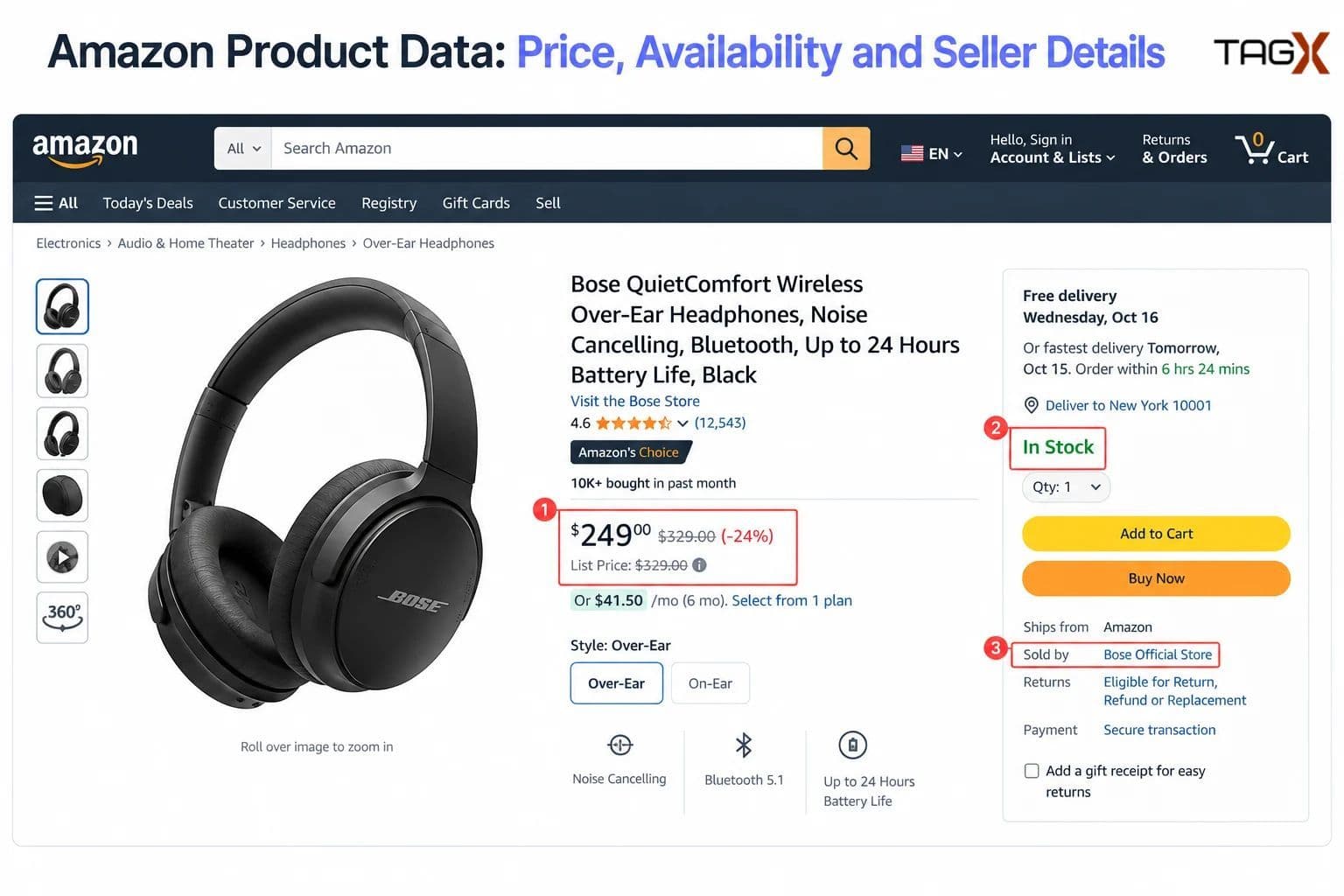
- Collect product and offer data. Capture available product details, selling prices, advertised discounts, seller information, stock status, and collection timestamps. Consistent collection provides a record that can be compared over time.
- Match equivalent products. Use product identifiers and attributes to distinguish exact matches from similar alternatives. Different variants, sizes, or pack quantities can make an otherwise straightforward price comparison misleading.
- Standardize the records. Normalize product attributes and currencies, and account for relevant differences such as delivery costs and seller offers. Regional variations should also be considered when comparing products across markets.
- Refresh the data at suitable intervals. The appropriate collection frequency depends on the product category, observed price volatility, and monitoring objective. Priority products may require more frequent updates than less competitive items.
- Retain and deliver the data. Timestamped records can be supplied through an API or structured formats such as CSV and JSON, depending on the workflow. This allows pricing teams and internal applications to work with consistent records rather than repeatedly checking individual product pages.
For a practical introduction to this process, TagX explains how to build an Amazon price tracker for ecommerce businesses. The same principles can be extended to additional marketplaces and retailer websites.
How Competitor Pricing Data Can Inform Black Friday Decisions
Collecting competitor data is only the first step. Its value comes from helping retailers identify meaningful changes and determine which products deserve closer attention.
- Identify significant price gaps. Comparing equivalent products across relevant retailers helps teams locate differences that may warrant a pricing review. The size of the gap, the importance of the product, and the retailer's commercial objectives all matter.
- Protect margins. A competitor's lowest price should be treated as a reference point, not an automatic target. Retailers need to consider their own costs, margins, inventory, and promotional plans before changing prices.
- Understand promotional activity. Current prices can be compared with historical observations to assess whether an offer represents a new movement or a recurring promotional pattern. This helps teams evaluate discounts with more context.
- Prioritize important products. Large catalogs can generate substantial amounts of competitor data. Product importance, category competition, and price volatility can help retailers determine where monitoring and review efforts should be concentrated.
- Consider availability alongside price. A lower-priced offer may be unavailable or supplied by a different seller. Examining stock status and seller information alongside pricing helps retailers make more meaningful comparisons.
TagX's Price Monitoring use case covers tracking product prices, discounts, promotions, and historical price changes across selected sources. This type of data can support competitor comparisons without requiring retailers to react to every observed movement.
The aim is to identify changes worth investigating, not to assume that every price difference requires an immediate adjustment.
Why Historical Price Data Matters During Black Friday
A current price shows what a product costs at a particular moment. Historical price data helps retailers understand how that price has changed.
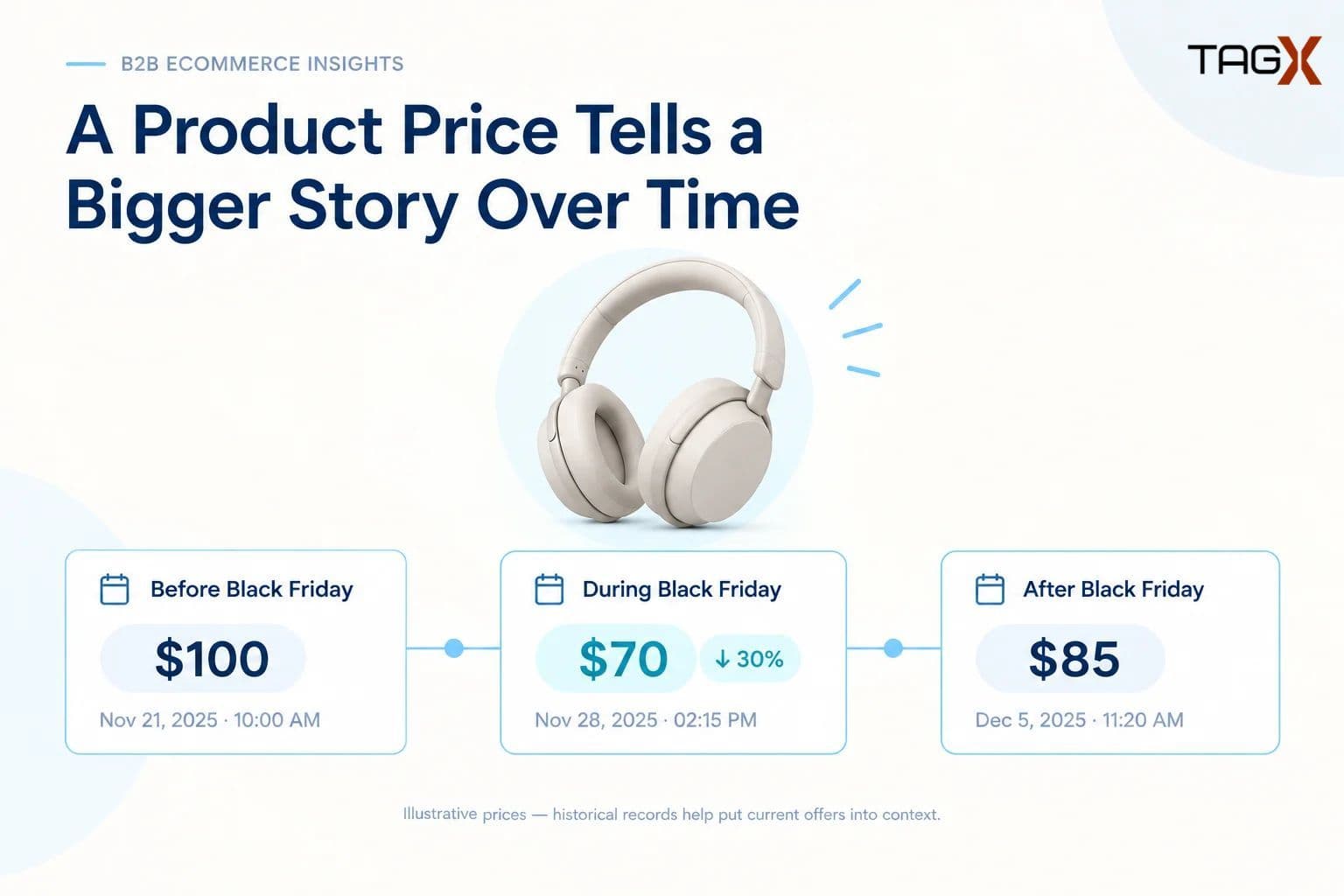
Imagine a product advertised at 30% off during Black Friday. The discount may look substantial, but the current listing alone does not show whether the product has become cheaper than it was earlier in the season or whether similar offers have appeared repeatedly.
A timestamped price history provides a reference for examining these changes.
Before Black Friday, retailers can collect baseline prices and availability across priority products. During the event, new observations can be compared with previous records to identify changes in competing offers. After the event, the accumulated data can help teams review how prices evolved throughout the shopping period.
Historical records can also reveal gaps in the monitoring process. If a product has only a few observations, there may not be enough information to describe its pricing pattern confidently. Consistent collection improves the basis for comparison, although it cannot guarantee that every price change will be captured.
Retailers looking to develop this approach further can explore Amazon price tracking for businesses: monitor competitors and market trends.
Scaling Competitor Monitoring With an Ecommerce Data API
Manually checking prices may work for a small selection of products. It becomes harder to maintain when retailers need to monitor large catalogs across multiple marketplaces and retailer websites.
A structured data pipeline can make this process more consistent by collecting product information, organizing it into standardized fields, and delivering records to the systems that need them.
Before choosing a data collection approach, retailers should evaluate several requirements:
- Source coverage: Does the process include the marketplaces and retailer websites relevant to the business?
- Refresh frequency: Can data be collected often enough for the intended monitoring objective?
- Product matching: Can equivalent products and variants be identified reliably?
- Data quality: Are missing fields, duplicate records, and inconsistent formats checked?
- Historical retention: Can timestamped observations be retained for future comparisons?
- Data delivery: Can records be supplied through an API or in structured CSV and JSON formats?
These considerations matter because collecting more data does not automatically produce better comparisons. Incorrect product matches, missing timestamps, and inconsistent price fields can undermine the quality of competitor analysis.
Retailers should also consider applicable source terms, access restrictions, and data collection requirements when designing their workflows.
When direct Amazon extraction becomes unreliable, TagX discusses alternatives to Amazon scraping. The appropriate approach depends on source coverage, collection requirements, desired data fields, and the reliability needed for the intended application.
An API-based workflow can help standardize data delivery, but source coverage, field completeness, and data quality should still be evaluated against the retailer's requirements.
Building a Black Friday Data Plan for 2026 and Beyond
Competitor monitoring should begin before the first major promotional wave, giving retailers time to establish baselines, validate product matches, and address data quality issues.
A practical preparation plan includes:
- Define priority products, categories, and competitor sources.
- Establish baseline prices and availability before the event.
- Choose an appropriate refresh schedule for each monitoring objective.
- Validate product matching and comparable pricing fields.
- Retain timestamped records for historical analysis.
- Review the collected data after Black Friday to identify recurring patterns and monitoring gaps.
The same process can support broader competitor analysis, helping retailers compare prices, product assortments, and availability beyond a single seasonal event.
Competing with Amazon on Black Friday 2026 does not mean matching every discount or monitoring every product equally. It means understanding which products matter, how competing offers change, and where reliable data can support better decisions.
With consistent ecommerce data collection and historical price records, retailers can move beyond isolated price checks and build a more informed approach to competitor monitoring.
Need ecommerce product and pricing data at scale? Talk to the TagX team about collecting structured data from relevant marketplaces and retailer sources.