


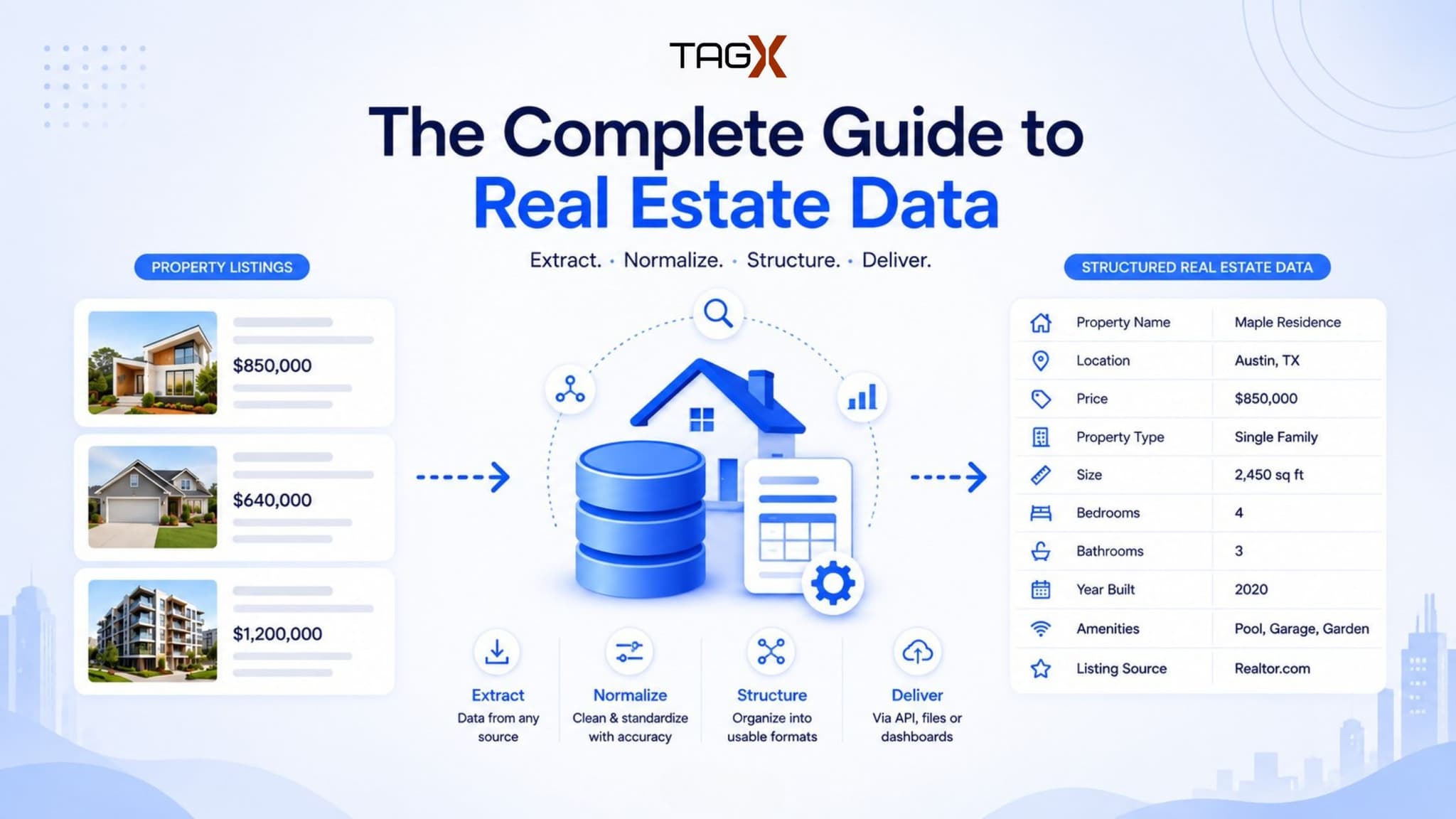
Real estate is no longer driven only by property visits, broker networks, and historical market reports. Today, businesses can track listings, asking prices, rental rates, transactions, neighborhood characteristics, development activity, and competitor movements at a much more granular level.
The challenge is that real estate data is rarely available in one clean, consistent format. Information is spread across property portals, government records, developer websites, brokerage pages, market reports, public databases, and other sources. Different platforms describe the same property in different ways, update information at different frequencies, and expose different fields.
For investors, PropTech companies, brokers, lenders, developers, and research teams, the real advantage comes from bringing these fragmented sources together and turning them into structured, usable information.
This guide explains the major types of real estate data, where they come from, how businesses collect and standardize them, and how they turn property information into better decisions.
What Is Real Estate Data?
Real estate data refers to structured and unstructured information about properties, markets, transactions, neighborhoods, companies, and development activity.
It can describe an individual property, such as its price, size, location, amenities, and listing status, or provide broader market signals such as rental trends, inventory levels, transaction volumes, and neighborhood demographics.
A typical real estate data ecosystem includes:
- Property listing data
- Property pricing and transaction data
- Rental data
- Market and housing data
- Neighborhood and location data
- Agent and brokerage data
- Development and construction data
- Commercial real estate data
The value of these categories increases when they can be connected. A property price becomes more meaningful when compared with nearby listings, historical transactions, rental yields, and neighborhood characteristics.
Major Types of Real Estate Data
1. Property Listing Data
Property listing data covers properties currently available for sale or rent. It typically includes:
- Property type, size, bedrooms, and bathrooms
- Price or rent
- Location and address
- Amenities, images, and floor plans
- Listing status
- Agent details
- Listing and update dates
Because listings change frequently, this data is useful for tracking inventory and pricing. For a closer look at the information a property record can contain, see Property Listing Data Explained.
2. Pricing & Transaction Data
This data captures both current and historical property values, including:
- Asking and sale prices
- Price per square foot or square meter
- Price changes
- Transaction dates
- Property valuations and tax information
Historical pricing helps businesses identify market trends rather than relying on current prices alone.
3. Rental Data
Rental data provides insight into the income potential and demand for properties. Common fields include:
- Asking and contract rent
- Rental history
- Availability
- Lease terms
- Furnishing and amenities
- Vacancy indicators
Investors and property managers can use this information to assess rental yields and benchmark pricing.
4. Market Data
Market data provides a broader view of real estate conditions across cities, regions, or property segments. It can include:
- Property and rental price trends
- Inventory and new listings
- Sales volume
- Days on market
- Supply and demand indicators
- Absorption rates
This helps businesses identify changing market conditions and emerging opportunities.
5. Neighborhood & Geospatial Data
Property value is strongly influenced by its surroundings. Neighborhood data may cover:
- Population and income
- Schools, hospitals, and transport
- Points of interest
- Employment centers
- Crime and walkability
- Geographic boundaries
Combined with property data, these signals support location analysis, site selection, and market research.
6. Agent & Brokerage Data
Agent data helps businesses understand who is active in a market and what they are selling. It can include:
- Agent and brokerage names
- Listing volume
- Property categories
- Geographic coverage
- New, sold, or rented listings
This information can support competitor and market activity analysis.
7. Development & Construction Data
Development data focuses on upcoming and active projects, including:
- Project and developer details
- Location and property type
- Unit count
- Launch and completion dates
- Construction status
- Amenities and available inventory
It helps businesses assess future supply and understand where new development is taking place.
Where Does Real Estate Data Come From?
There is no single source of truth for real estate data. Businesses typically combine multiple sources depending on the use case.
Property Portals and Listing Websites
Property portals are a major source of current listing information. They can provide asking prices, property specifications, amenities, availability, agent details, and listing history.
For businesses requiring large-scale coverage, Web Scraping can be used to collect publicly available information from relevant sources and transform it into a consistent format, subject to applicable permissions and website terms.
Government and Public Records
Government sources can provide information such as:
- Property registrations
- Tax records
- Planning information
- Land records
- Building permits
- Project registrations
- Housing-price indices
These sources can be especially useful for validating information collected from commercial or listing sources.
Developer and Brokerage Websites
Developers frequently publish project-level information that may not be available through broader property portals. Brokerage websites can also provide localized inventory and agent information.
Market Research and Industry Reports
Research organizations and industry bodies publish market-level information covering housing prices, sales, supply, rental trends, and commercial real estate.
These sources are often useful for macro-level analysis and benchmarking.
APIs and Data Providers
A Custom Data API can provide a more automated way to deliver structured real estate information into an internal application, database, analytics workflow, or PropTech product.
Instead of repeatedly collecting information manually, businesses can define the fields they need and receive standardized records through an API or another delivery format.
How Businesses Collect Real Estate Data
Collecting real estate data at scale is usually a structured process that turns information from multiple sources into clean, usable records.
Step 1: Define What You Need
Start with the business objective and required fields. An investment team may need prices, rental estimates, locations, and property history, while a marketplace may require listings, amenities, images, and availability.
Step 2: Identify Data Sources
Businesses can combine property portals, developer and brokerage websites, public records, market reports, APIs, and other relevant sources. Using multiple sources helps build broader and more complete coverage.
Step 3: Collect the Data
Depending on the source, data can be collected through APIs, licensed feeds, public records, or Web Scraping where appropriate.
For example, a property listing collected from a source might be structured like this:
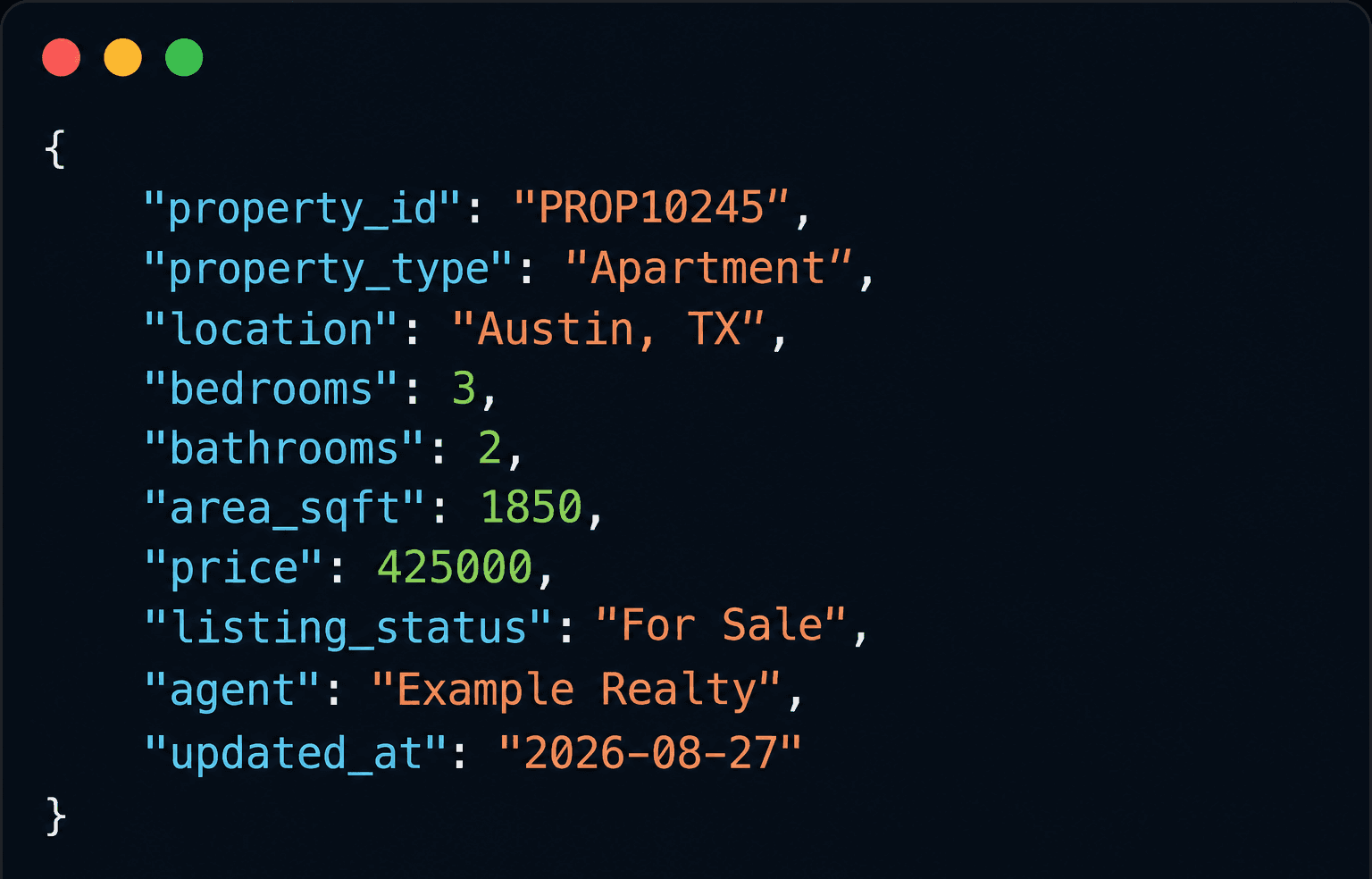
This illustrates how information that may appear differently across websites can be converted into consistent fields.
For a practical look at collecting property listings, see How to Scrape Real Estate Listings: A Step-by-Step Guide to Collecting Property Data.
Step 4: Clean and Standardize
Raw data often contains inconsistent names, units, currencies, addresses, and property types. Businesses normalize these fields, remove duplicates, validate missing values, and standardize formats so records from different sources can be compared.
Step 5: Match and Deduplicate
The same property may appear across multiple platforms. Addresses, coordinates, listing IDs, URLs, and property attributes can help identify duplicate records and create a more accurate property profile.
Step 6: Structure and Deliver
Once cleaned, the data can be organized into a consistent schema and delivered through CSV, JSON, databases, or a Custom Data API for use in applications, analytics, and internal workflows.
Step 7: Keep It Updated
Real estate data changes constantly. Prices, availability, listings, and development statuses can change within days or even hours, so the collection pipeline should use a refresh schedule that matches the business need.
Turning Raw Property Data Into Business Intelligence
The real value of real estate data appears when businesses connect multiple data categories.
For example:
Listing data + pricing history + neighborhood data = stronger investment screening
Rental data + property characteristics + market trends = rental pricing intelligence
Agent data + listing activity + geography = competitive intelligence
Development data + inventory + market demand = supply analysis
The goal is not simply to collect more records. It is to create a consistent information layer that allows teams to compare properties, markets, competitors, and opportunities.
Real Estate Data Use Cases
Market Research
Research teams can monitor property prices, rental trends, supply, demand, and inventory across cities or neighborhoods.
Instead of relying solely on periodic reports, continuously collected information can provide a more current view of market conditions.
Investment Analysis
Investors can compare properties based on asking price, historical changes, rental potential, location, and surrounding market conditions.
For a deeper look at how investment teams can apply property information, How Companies Use Real Estate Investment Data explores several practical applications.
Pricing Intelligence
Developers, brokers, and property managers can compare their prices against similar properties.
Tracking price changes across competitors can reveal whether a market is becoming more price-sensitive or whether certain properties are consistently positioned above or below their peers.
Competitive Intelligence
Businesses can monitor competitor inventory, geographic expansion, pricing, new developments, and listing activity.
This helps answer questions such as:
- Which markets are competitors entering?
- What property types are they focusing on?
- How are their prices changing?
- Which locations have the highest inventory?
Property Discovery and PropTech
Real estate platforms can use structured property feeds to power search, recommendation, comparison, valuation, and discovery features.
A structured feed can also be integrated into internal applications through APIs, databases, or other delivery systems.
How to Choose a Real Estate Data Solution
The right approach depends on what you need the data to accomplish.
Before choosing a provider or collection method, evaluate:
| Requirement | Questions to Ask |
|---|---|
| Coverage | Which markets and sources are available? |
| Fields | Does the data contain the exact attributes required? |
| Freshness | How frequently is information refreshed? |
| Accuracy | How are errors and missing values handled? |
| Standardization | Are locations, prices, units, and property types normalized? |
| Scale | Can the solution support your expected volume? |
| Delivery | API, CSV, JSON, database, or another format? |
| Customization | Can new sources or fields be added? |
There is no universal "best" real estate data solution. The appropriate option depends on geography, data type, freshness requirements, scale, and intended use. A broader comparison of available approaches is covered in Best Real Estate Data Solutions in 2026.
The Future of Real Estate Data
Real estate is becoming increasingly data-driven, but the advantage will not come simply from having access to more information.
The stronger opportunity lies in combining fragmented sources into a reliable, continuously refreshed information layer.
As PropTech platforms, investment firms, developers, lenders, and research teams become more data-dependent, demand will grow for property information that is structured, standardized, current, and accessible through automated workflows.
That means businesses should think beyond collecting individual listings. The long-term goal is to build a repeatable data pipeline that can capture information from relevant sources, normalize it into a common structure, maintain historical changes, and deliver it where teams and applications can actually use it.
Final Takeaway
Real estate data spans far more than property prices and listings. It includes rental information, transactions, neighborhood characteristics, agent activity, market trends, development projects, and other signals that explain how property markets behave.
The biggest challenge is fragmentation. Data comes from many sources, each with different formats, definitions, update schedules, and levels of detail.
A strong real estate data strategy combines source discovery, data collection, Web Scraping where appropriate, normalization, deduplication, validation, historical tracking, and automated delivery.
When these pieces work together, raw property information can become a foundation for market research, investment analysis, pricing intelligence, competitive intelligence, and better real estate decisions.
If you’re exploring how to collect and structure real estate data for your specific business needs, talk to our team to discuss the right approach for your data requirements.